
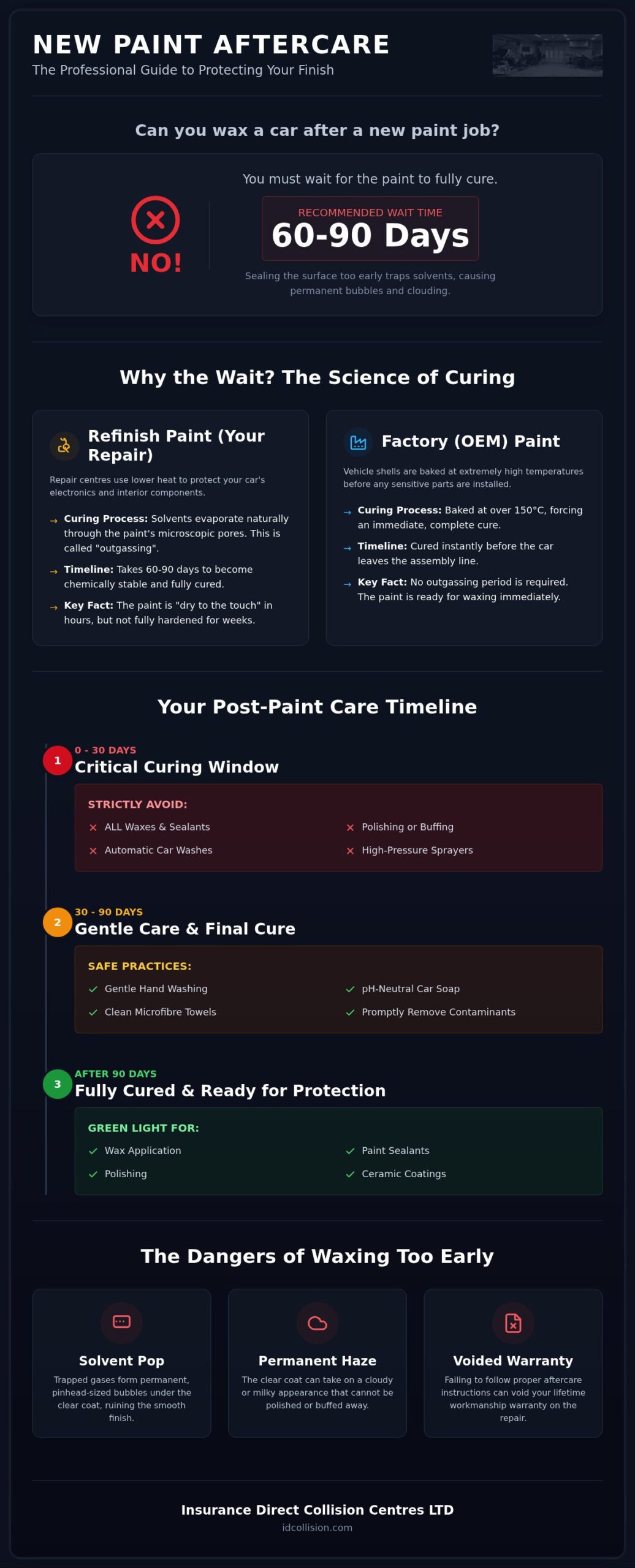
Applying a fresh coat of wax to your car’s new finish might seem like the best way to protect your investment, but doing it too early is actually the fastest way to suffocate the paint. If you seal the surface before the solvents have fully escaped, you risk trapping gases that lead to permanent clouding or “solvent pop” bubbles. You are likely asking, can you wax a car after new paint job right away? The short answer is no; your paint needs time to breathe before it can be shielded.
We understand the anxiety that comes with driving a freshly painted vehicle through Ontario’s unpredictable weather. You want to guard that deep colour against road salt and grit, yet you don’t want to accidentally void your repair warranty or cause lasting damage. This guide provides the precise timeline and professional techniques you need to protect your vehicle safely. We will walk you through the essential maintenance schedule, explain the vital difference between “dry” and “cured” paint, and recommend the gentle cleaning products that keep your finish pristine while you wait for that first safe wax application.
Key Takeaways
- Understand why the answer to “can you wax a car after new paint job” is a firm 60-to-90-day wait to ensure solvents can escape without damaging the finish.
- Learn the specific hand-washing methods that keep your vehicle clean without risking the scratches or pressure damage caused by automatic car washes.
- Discover the science of outgassing and why sealing the paint too early can lead to permanent clouding or “solvent pop” bubbles.
- Follow a professional timeline to transition safely from a fresh shop finish to long-term surface protection like wax or ceramic coatings.
- Ensure your lifetime workmanship warranty stays intact by adhering to the precise aftercare instructions provided by your refinishing specialist.
Understanding the Science: Why You Must Wait to Wax New Paint
A fresh paint job is more than just a cosmetic upgrade; it is a complex chemical event. When you see your car gleaming in our Kingston delivery bay, the finish looks perfect and feels solid. However, the internal structure of that finish is still very much in motion. Unlike the paint on your living room walls, professional automotive paint relies on a specific balance of resins, pigments, and solvents that must stabilize over several weeks. If you rush to apply a sealant, you aren’t just adding protection; you are interfering with a critical curing cycle. This is the primary reason why the answer to can you wax a car after new paint job is always a patient “not yet.”
The core of the issue lies in how we refinish vehicles compared to how they are painted at the factory. Original equipment manufacturer (OEM) paint is applied to a bare shell and baked at temperatures exceeding 150 degrees Celsius. This high-heat environment cures the finish instantly. In a collision repair setting, we cannot bake your entire vehicle at those temperatures without damaging the sensitive electronics, interior plastics, and rubber seals. Instead, we use specialized paint booths that use lower heat to accelerate the initial drying. While this makes the car safe to drive, the paint remains chemically active for a much longer period than a factory finish.
The Outgassing Process Explained
Outgassing is the technical term for the evaporation of solvents through the microscopic pores of your clear coat. Think of these solvents as the delivery vehicle for the paint; once the paint is on your car, their job is to leave. If you apply a layer of wax or a synthetic sealant too early, you create a non-porous barrier that traps these gases. This trapped pressure often results in “solvent pop,” which appears as tiny, pinhead sized bubbles on the surface. In other cases, the trapped gas causes the clear coat to take on a cloudy or hazy appearance that no amount of polishing can fix. To maintain the integrity of your finish, the paint must remain “open” to the air.
Dry to the Touch vs. Chemically Cured
One of the most dangerous myths in car care is the “thumbprint test.” Many drivers believe that if the paint feels hard and doesn’t hold a fingerprint, it is ready for wax. This is a fallacy. Modern clear coats are designed to be “dust-free” and dry to the touch within hours so the vehicle can be moved. However, being dry is not the same as being cured. The chemical cross-linking that gives the paint its final strength and chip resistance takes much longer. Even if the surface feels like glass, the layers underneath are still settling. At Insurance Direct Collision Centres, we prioritize the longevity of your repair, which is why we insist on a 60 to 90 day window before any heavy waxes are applied to the new colour.
The Post-Paint Timeline: When Is It Safe to Wax?
When drivers ask, can you wax a car after new paint job, they are usually looking for a single, magic number. While some retail products suggest a few weeks is plenty, professional-grade refinishing requires a more conservative approach. The standard industry recommendation for a full panel repair is between 60 and 90 days. This buffer ensures that the thicker clear coat applied in a professional booth has stabilized entirely. Rushing this process might save you a few minutes today, but it could cost you the depth and clarity of your finish tomorrow.
The first month is the most volatile period for your new colour. During this time, the paint is still shedding solvents at a high rate. If you disturb the surface with heavy pressure or chemical sealants, you risk altering the way the clear coat levels out. This is a crucial part of caring for your newly painted vehicle properly. You should avoid any products containing silicone during this window, as these chemicals can migrate into the paint and cause permanent defects that are difficult to correct later.
The 30-Day Critical Window
During the initial 30 days, you must maintain a strict “no-wax” zone. This prohibition includes spray waxes, wash-and-wax soaps, and even certain “breathable” polishes. While some products claim to be safe for fresh paint, we advise extreme caution. Prematurely sealing the surface can lead to a dull, milky haze that is trapped beneath the wax layer. This clouding is often irreversible without sanding and re-clearing the panel. It is better to let the car look slightly less shiny for a few weeks than to ruin the work permanently. You can generally tell your paint is stabilizing when:
- The faint “new paint” chemical scent has completely dissipated.
- The surface feels exceptionally slick rather than slightly tacky to a gentle touch.
- The 60-day mark on your calendar has passed.
Factors That Influence Curing Time in Ontario
Living in Kingston means our vehicles face unique environmental challenges. Determining exactly when can you wax a car after new paint job often depends on the weather. High humidity during our Ontario summers can actually slow down the evaporation of solvents, effectively extending the curing window. Conversely, extreme winter cold can slow the molecular settling of the paint. If your repair was completed during a deep freeze, keeping the car in a heated garage for the first week is a best practice. This controlled environment allows the chemical cross-linking to begin without being shocked by sub-zero temperatures. If you have questions about your specific finish, our experts at Insurance Direct Collision Centres can review your collision repair details and give you a firm date for your first safe wax application.
How to Safely Clean Your Vehicle While the Paint Cures
You’ve just invested in a professional finish, so it’s natural to worry about the first speck of dust or splash of mud. While the answer to can you wax a car after new paint job remains a firm “wait,” that doesn’t mean you must let dirt accumulate. Keeping the surface clean is actually vital for the health of the curing clear coat. However, you must temporarily retire your usual cleaning routine. Commercial car washes, even the “touchless” varieties, often use harsh alkaline chemicals or high-pressure wands that can etch or displace the soft, fresh resins.
Instead, focus on a gentle, low-pressure approach. Use a pH-neutral automotive shampoo that is specifically labelled as “non-wax” or “wax-free.” Many common car soaps contain gloss enhancers or liquid waxes designed to leave a film behind. As we discussed earlier, any film that seals the surface will interfere with the outgassing process. A pure, pH-neutral soap provides the lubrication needed to lift dirt without leaving a trace or harming the delicate chemical bond of your new paint.
Safe Hand-Washing Techniques
The safest way to maintain your vehicle is the two-bucket method. Fill one bucket with soapy water and the second with plain, clean water. Each time you wipe a section of the car, rinse your wash mitt in the plain water first. This simple step ensures that grit and contaminants are trapped in the rinse bucket rather than being ground back into your soft clear coat. Use only high-GSM (grams per square metre) microfiber towels for drying. Sponges and old-fashioned chamois can act like sandpaper on a fresh finish. Always perform this task in the shade. If the metal gets too hot, the water will evaporate instantly, leaving behind mineral deposits or water spots that are difficult to remove from uncured paint.
Protecting the Finish from Environmental Hazards
In Kingston, our cars face a constant barrage of environmental threats. Bird droppings and tree sap are particularly dangerous for new paint because they are highly acidic. If left to sit, they can eat through the soft clear coat in a matter of hours. If you spot these contaminants, rinse them away immediately with cool, low-pressure water. During our winter months, road salt poses a similar risk. While you should rinse salt off frequently, avoid the temptation to “dry wipe” a dusty or salty panel with a cloth. Without the lubrication of water and soap, you will create thousands of micro-scratches. Think of your new paint as a “work in progress” for the first 90 days. Treat it with the same precision and care our technicians used during the refinishing process.
Selecting the Right Protection Once the Curing Period Ends
Reaching the 90-day milestone is a significant moment for your vehicle. By now, the outgassing process has finished, and the resins in your clear coat have reached their maximum hardness. This is the point where the question shifts from “can you wax a car after new paint job” to “which protection should I choose?” Your goal now is to lock in that automotive refinishing Kingston quality and defend it against the elements. However, don’t just grab the first bottle of wax you see on a shelf. The first application of protection requires a strategic approach to ensure you aren’t sealing in contaminants that accumulated while the paint was “open.”
Before you apply any sealant, evaluate the surface under direct light. Even though the paint is new, it has been exposed to the environment for three months without any protection. You might notice a slight loss of “pop” or a very fine layer of industrial fallout. A light finishing polish is often a smart move here. It removes minor surface oxidation and perfectly levels the clear coat, ensuring your chosen wax or sealant bonds directly to the paint rather than a layer of microscopic road film. This precision ensures your finish remains as deep and vibrant as the day it left our shop.
Wax vs. Sealants vs. Ceramic Coatings
Choosing your shield depends on how you use your vehicle and how much time you want to spend on maintenance. Natural Carnauba wax is the classic choice. It provides a warm, deep glow that is unmatched for show-car finishes, though it typically only lasts about six to eight weeks. For drivers facing Ontario winters, synthetic sealants are often a better fit. These man-made polymers create a tighter bond and provide a more durable shield against road salt and UV rays. If you are looking for a more permanent solution, ceramic coatings offer years of protection and incredible water-shedding properties. Just be aware that many high-end ceramic installers suggest waiting a full 180 days rather than 90 to ensure the coating adheres perfectly to the fully settled finish.
Preparing the Surface for Its First Wax
Precision is the hallmark of a professional finish. After the 90-day mark, we recommend a thorough chemical decontamination before waxing. Use a dedicated iron remover to dissolve “rail dust” or tiny metallic particles that may have embedded in the soft paint during the curing phase. Once the surface is chemically clean, apply your protection in thin, even layers. Many owners make the mistake of globbing on thick coats of wax, thinking more is better. In reality, thick layers are harder to buff off and can lead to uneven product buildup. If you want to ensure your vehicle receives a professional-grade start to its protected life, consider our expert detailing services to handle the first post-cure application for you.
Professional Refinishing and Long-Term Care in Kingston
Restoring your vehicle after an accident is a process built on trust. At Insurance Direct Collision Centres, we don’t just see ourselves as a repair shop; we act as your protective expert throughout the entire restoration journey. We understand that once you drive away, you want to maintain that showroom glow for as long as possible. The question of can you wax a car after new paint job is often the first thing on a driver’s mind, and our role is to provide the honest, straight-talk advice you need to protect your investment. By following the specific timeline we’ve outlined, you ensure that the chemical bond of your clear coat remains uncompromised, preserving the deep lustre we worked so hard to achieve.
Maintaining the resale value of your vehicle depends heavily on the integrity of its exterior finish. A poorly timed wax application can lead to surface defects that a future buyer will notice immediately. Conversely, a vehicle that has been allowed to cure properly and then shielded with high-quality products will retain its value and structural beauty for years to come. We are committed to helping you navigate these nuances so your car remains a source of pride rather than a source of stress.
Why Our Precision Painting Process Matters
The durability of your new finish starts long before you pick up your keys. We utilize a specialized painting process that prioritizes longevity and factory-level precision. Our technicians use high-quality paints and clear coats specifically formulated for collision repair Kingston Ontario. By performing every application in a strictly controlled environment, we minimize the risk of contaminants like dust or moisture getting trapped in the finish. This attention to detail allows us to perfectly match factory textures, including the subtle “orange peel” effect found on modern vehicles, ensuring your repair is virtually invisible.
Our Lifetime Warranty on Refinishing Work
We stand behind our craftsmanship with a lifetime warranty on all refinishing work. This coverage includes protection against paint adhesion issues, peeling, or premature fading, provided the vehicle is cared for according to professional standards. Following our specific aftercare sheet is not just about keeping the car clean; it’s about warranty compliance. If you apply a sealant too early and cause solvent pop, it can complicate future claims. We want to be your ally in this process. If you ever have concerns about how your finish is settling, we invite you to stop by for a free estimate or post-repair inspection. Our Kingston-owned and operated team is always here to ensure your vehicle receives the specialized care it deserves.
Protecting Your Investment for the Long Haul
Patience is the ultimate tool for preserving a professional automotive finish. By respecting the 60 to 90 day curing window and sticking to gentle, pH-neutral hand washing, you allow the solvents to escape properly and the resins to reach their full strength. Understanding the science behind why can you wax a car after new paint job only after a full cure ensures you won’t face the heartbreak of solvent pop or permanent clouding. Once that timeline passes, your reward is a finish that retains its depth and lustre for years.
At Insurance Direct Collision Centres, we take the stress out of the restoration process. We offer direct insurance billing to handle the paperwork for you and provide expert colour matching for all makes and models. Every paint job we perform comes with a Lifetime Warranty on workmanship, giving you total peace of mind. We are here to act as your advocate, ensuring your vehicle is restored to its factory-grade glory with precision and care.
Ready for a flawless finish? Get your free collision repair estimate from our Kingston experts today
Frequently Asked Questions
How long after a paint job can I wash my car?
You can typically give your vehicle a gentle rinse with cool water 24 to 48 hours after the work is completed. However, you should wait at least two weeks before performing a full hand wash with pH-neutral soap. This initial window allows the surface to harden enough to resist light water pressure without marring. Always avoid commercial car washes for the first 90 days to prevent mechanical damage from heavy brushes.
Will rain damage my new car paint if it hasn’t cured yet?
Rain will not structurally damage your new paint once it has dried to the touch, but it can leave behind unsightly mineral deposits. Because the clear coat is still “open” during the first few weeks, acid rain or hard water can etch the surface more easily. If your car gets caught in a storm, rinse it with clean water and dry it gently with a high-GSM microfiber towel to prevent spotting.
Can I use a car cover on a freshly painted vehicle?
You should avoid using a car cover for at least 60 to 90 days. Covers can trap moisture and escaping solvents against the finish, which leads to clouding or “printing” where the fabric texture leaves a permanent mark in the soft clear coat. Additionally, any dust trapped between the cover and the car will act like sandpaper as the cover moves in the wind, causing fine scratches on the delicate surface.
Is it safe to use a pressure washer on new paint?
Using a high-pressure washer is risky during the curing phase and could lead to the paint lifting or peeling. The bond between the new layers and the vehicle body is still stabilizing; therefore, the concentrated force of a pressure wand can be too aggressive. Stick to a standard garden hose with a gentle spray nozzle for the first three months to ensure you don’t accidentally compromise the edges of the repair.
What happens if I accidentally waxed my car too early?
If you accidentally sealed the surface, you may notice a milky haze or tiny bubbles known as solvent pop. This happens because the wax prevents the necessary outgassing of solvents. If this occurs, don’t panic. You can often safely remove the wax using a wax-remover or a diluted isopropyl alcohol solution. Once the wax is gone, the paint can resume its natural curing process without further interference.
Can I use “spray wax” or “quick detailer” during the curing period?
Most spray waxes and quick detailers contain silicones or gloss enhancers that seal the paint pores. Even if the product feels light, it still creates a barrier that interferes with the curing cycle. When you wonder can you wax a car after new paint job, remember that “wax” includes these convenient spray-on products. Use a pure, wax-free detailer only if it is specifically labelled as “body shop safe” by the manufacturer.
Does the colour of the paint affect the curing time?
The specific pigment doesn’t change the chemical curing rate, but darker colours like black or deep blue absorb more heat from the sun. This increased surface temperature can slightly accelerate the outgassing process compared to lighter shades like white or silver. Regardless of the colour, the 60 to 90 day rule remains the safest standard for ensuring the clear coat has reached its full structural integrity and chemical stability.
Should I park my car in the sun to help the paint cure faster?
You should avoid parking in direct, intense sunlight for extended periods during the first 30 days. While warmth helps solvents evaporate, extreme heat can cause the paint to cure unevenly or lead to “baking” in contaminants like bird droppings or tree sap. A shaded, well-ventilated area is the ideal environment. This allows for a steady, controlled outgassing process without the risk of UV damage or surface overheating.