
Could a minor-looking dent actually compromise your vehicle’s entire safety system? You are likely staring at a crumpled fender or a scraped door, feeling the weight of insurance claims and the worry that your car will never be the same. It’s a stressful position to be in, especially when you’re asking yourself, when is body panel replacement necessary to protect your family and your vehicle’s resale value? You want a result that looks perfect and performs exactly as the manufacturer intended, without cutting corners that lead to rust or structural failure down the road.
We understand that you need an advocate who prioritizes your safety over a quick fix. In this guide, you’ll learn the critical indicators that demand a full panel replacement rather than a simple repair to ensure your car returns to factory safety standards. We will explore how modern high-strength steels and sensitive ADAS sensors, which now require calibration in over 65% of all collision repairs, have fundamentally changed the standards for a safe and successful restoration. You deserve a process that is transparent and a finish that restores your car to its original factory colour.
Key Takeaways
- Recognize the “point of no return” where metal loses its structural memory and can no longer provide adequate protection in a future impact.
- Understand when is body panel replacement necessary to prevent repair materials from interfering with sensitive ADAS sensors and radar systems.
- Identify why surface rust in the Kingston area often hides deeper structural perforation that requires a full panel swap for long-term protection.
- Evaluate the “labour versus material” balance to determine if a new factory panel is actually a more cost-effective choice than extensive manual repair.
- Learn how to navigate insurance claims while exercising your right to choose a repair facility that offers a lifetime warranty on workmanship.
The Threshold: Understanding When a Panel Crosses the Line from Repair to Replacement
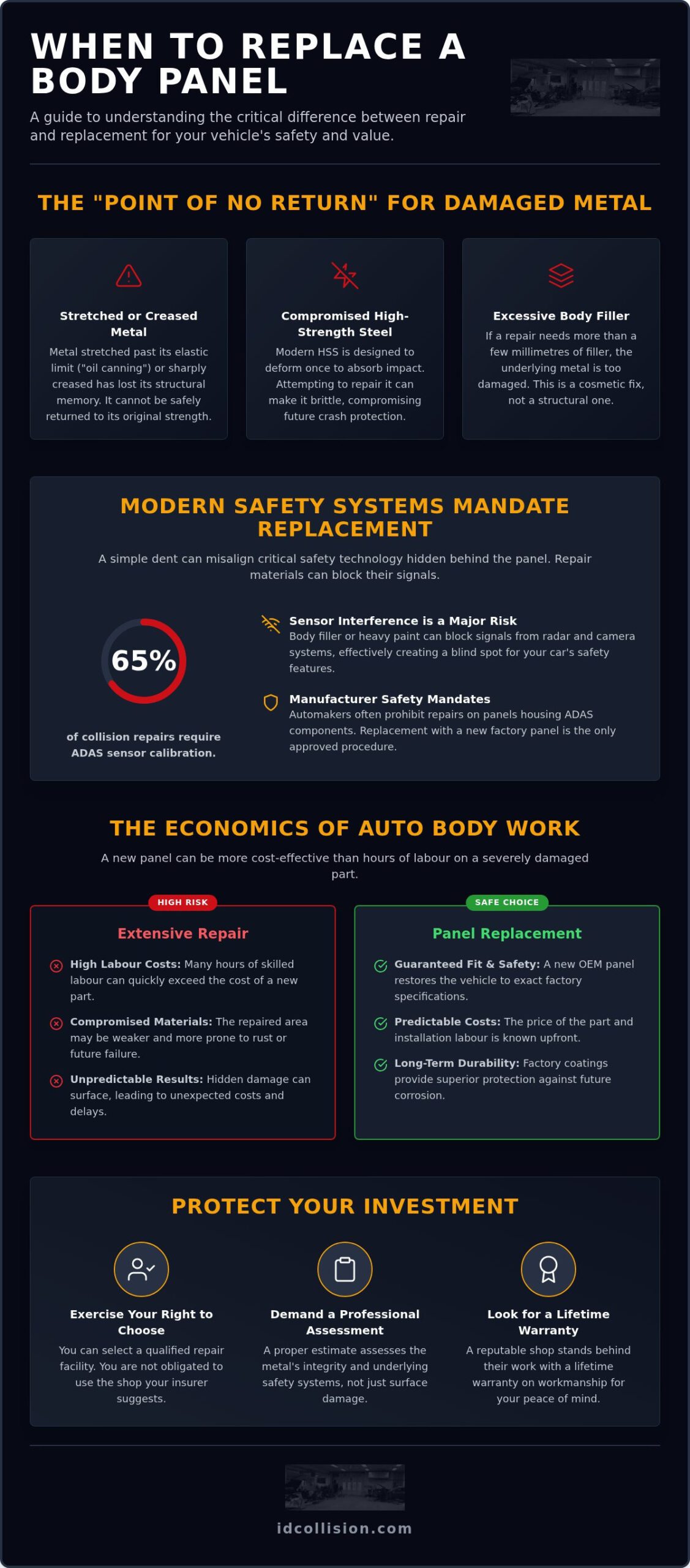
After an accident, the visual damage is just the starting point. Determining when is body panel replacement necessary depends on the physical state of the metal itself. Every vehicle panel has a “memory” established during the manufacturing process. When a collision occurs, the force can push metal past its elastic limit. Once it crosses this “Point of No Return,” the molecular structure is permanently altered. This isn’t just about looks; it’s about how the car will behave if you’re ever in another accident.
This structural compromise often leads to a condition technicians call “oil canning.” If you press on a repaired panel and it pops in and out with a metallic “clink,” the metal has been stretched too thin. It no longer has the tension required to support the vehicle’s shape or provide future impact protection. Most modern Canadian vehicles utilize high-strength steel (HSS) to increase safety while reducing weight. Unlike older mild steels, HSS is designed to absorb energy by deforming in a specific way. Attempting to straighten these components often makes them brittle. This is why a professional must decide whether to repair or replace parts to maintain factory safety standards.
Metal Stretching and Structural Integrity
Impact force generates heat at a microscopic level. This heat, combined with the physical displacement of the metal, creates thin spots that cannot be “massaged” back to their original strength. If a shop tries to pull this metal back into shape, they risk creating a panel that looks fine but lacks the integrity of the original. Your vehicle’s crumple zones are precision-engineered. Any attempt to repair a severely stretched structural component, like a quarter panel or a pillar, could cause those zones to fail in a future collision. Replacement ensures the metal performs exactly as the manufacturer intended.
When PDR is No Longer an Option
We often recommend paintless dent repair Kingston because it preserves your factory finish and is highly efficient for minor dings. However, PDR has its limits. If the metal is sharply creased or the paint shows even microscopic cracking, the structural bond is broken. Another major red flag is the excessive use of body filler. If a repair requires more than a few millimetres of filler to look smooth, the underlying metal is too compromised to be safe. In these cases, when is body panel replacement necessary becomes a question of long-term quality and your peace of mind.
Beyond the Surface: Why Modern Vehicle Safety Systems Mandate Panel Replacement
Modern vehicles are no longer just shells of steel and plastic. They are sophisticated arrays of sensors and safety equipment. Determining when is body panel replacement necessary often depends more on the hardware hidden behind the paint than the dent itself. As of 2026, over 65% of all collision repairs require some form of Advanced Driver Assistance Systems (ADAS) calibration. When a bumper or door panel is damaged, the sensitive radar units and cameras mounted behind them can be knocked out of alignment by even a millimetre. These components are precision-tuned to “see” through a specific thickness of factory material. If a shop attempts a repair using heavy body fillers or multiple layers of paint, they risk creating a “blind spot” for your vehicle’s safety brain.
Recent industry mandates have shifted the standard toward replacement for sensor-heavy areas. For example, General Motors issued a policy in June 2026 strictly prohibiting the use of salvaged or aftermarket parts for ADAS-related components, including bumper fascias. This isn’t just a corporate preference; it’s a safety requirement. Repair materials can interfere with the radio frequency signals used by blind-spot monitors and cross-traffic alerts. To ensure your vehicle continues to meet Federal Motor Vehicle Safety Standards, installing a new, factory-spec panel is often the only way to guarantee these life-saving technologies function correctly. If you’re unsure about the tech behind your damage, our team can provide a detailed safety assessment of your vehicle’s sensors.
ADAS Sensors and Blind Spot Monitoring
Your vehicle’s blind-spot monitoring relies on radar waves that pass through your bumper. If that bumper has been patched with plastic filler, the radar signal may be distorted or blocked entirely. This leads to intermittent sensor failure or, worse, a system that fails to warn you of a nearby car. Following a bumper repair Kingston ON, a full recalibration is mandatory. Using original equipment manufacturer (OEM) panels ensures the material density is exactly what the sensors expect, maintaining the integrity of your safety net.
Crumple Zones and Passenger Safety
Engineers design every panel to fold and collapse in a specific sequence to dissipate energy during a crash. When a panel is repaired rather than replaced, the added stiffness from welds or fillers can change how that metal reacts. Instead of folding to absorb the blow, a “stiff” repaired panel might transfer that dangerous force directly into the passenger cabin. Choosing replacement for structural panels ensures your vehicle remains a 5-star safety rated environment, protecting your family just as the factory intended.
Rust and Corrosion: When Surface Fixes Often Fail on Compromised Metal
For drivers in Kingston, the battle against the elements is a year-round struggle. Our winter roads are treated with heavy concentrations of salt and liquid brine, which are highly effective for safety but devastating for vehicle longevity. You might notice a small cluster of bubbles near your wheel well or at the bottom of a door. While it looks like a minor cosmetic blemish, this is often the “Iceberg Effect.” In our experience, what appears on the surface is usually just a fraction of the oxidation happening underneath. By the time paint begins to blister, the metal has often been perforated from the inside out.
Many owners ask when is body panel replacement necessary rather than just a quick sand-and-paint job. The answer lies in the depth of the damage. Grinding away surface scale and applying body filler is often a temporary band-aid. Because rust is a chemical reaction, any microscopic traces left behind will continue to spread under the new paint. Within one or two Canadian winters, that “repair” will likely fail, leaving you back at square one. If the structural integrity of the panel is compromised or the rust has reached the hem flanges where metal sheets are folded together, replacement is the only permanent cure to protect your investment.
The Reality of Ontario Road Salt
Liquid brine is particularly insidious because it’s designed to stick to surfaces. It find its way into every seam, crevice, and hem flange of your vehicle. Once trapped, it creates a moisture-rich environment that accelerates rot. There is a significant difference between surface scale, which can sometimes be cleaned, and structural rot that has thinned the metal. Our auto body restoration services prioritize starting with clean, uncompromised metal. We know that trying to save a salt-damaged panel often costs more in the long run than simply installing a fresh, factory-sealed component.
Preventing the Spread of Oxidation
One of the biggest risks of “patching” rust is the potential for oxidation to migrate to the vehicle’s frame or adjacent panels. A new replacement panel comes with a factory-applied e-coat, a specialized primer that is electrostatically dipped to ensure 100% coverage, even in hidden internal cavities. This level of protection is impossible to replicate with a spray gun on an old, repaired part. Whether you drive a domestic truck or a high-end import, choosing to replace a compromised panel ensures your car maintains its aesthetic value and structural health for years to come. It’s the most reliable way to stop the “rust clock” and keep your vehicle looking its best in the Kingston climate.
The Economics of Auto Body Work: Calculating the Cost-Benefit of New Panels
Deciding between a patch job and a fresh start isn’t just about safety; it’s a cold, hard financial calculation. In the world of professional bodywork, the balance between labour costs and material expenses is the deciding factor. You might assume that hammering out a dent is always cheaper than buying a new part. However, if a skilled technician spends five or six hours on a complex dent, the labour bill often climbs higher than the cost of a factory fender. This is one of the most common scenarios where we explain to our clients when is body panel replacement necessary to protect their wallet as much as their vehicle.
Insurance companies often prefer “repair” because it saves them on the high cost of brand-new parts. They might push for a cheaper fix that involves heavy filler and extensive sanding. As your advocate, we look at the long-term picture. A repaired panel that eventually cracks or shows “ghosting” from old damage will destroy your vehicle’s resale value. When a potential buyer sees a clean Carfax with a professionally documented panel replacement, it builds more confidence than a history of “repaired” structural components. We believe in doing the job correctly the first time to ensure your asset retains its maximum value.
The 70-80% Rule in Collision Repair
Adjusters typically use a 70% to 80% threshold to determine if a vehicle is a total loss. If the total estimate reaches this percentage of the car’s actual cash value, it’s often written off. High-quality automotive refinishing Kingston is a significant part of this cost. Whether we paint a new panel or a repaired one, the prep work and paint supplies remain similar. By choosing a new panel, you ensure that the finish is applied to a perfectly smooth, factory-primed surface. This reduces the chance of future peeling or fading that often plagues heavily filled repairs. It’s often more economical to start with a fresh surface than to fight with compromised metal.
OEM vs. Aftermarket Panels
Not all replacement panels are created equal. We always prioritize Original Equipment Manufacturer (OEM) parts because they are the only ones guaranteed to fit your vehicle’s specific geometry and pass original crash-test standards. Aftermarket panels often have thinner metal or slightly different dimensions, which can lead to unsightly gaps or “whistling” at highway speeds. When you book your collision repair Kingston Ontario, check your policy for an OEM endorsement. This ensures your insurance provider covers the cost of genuine parts rather than generic substitutes. If you’re dealing with an active claim and want an honest assessment of your vehicle’s value, request a professional estimate from our Kingston team today.
Navigating Your Claim: How a Professional Assessment Protects Your Investment
Dealing with insurance adjusters can feel like learning a second language while under immense pressure. We’ve already discussed the technical reasons for when is body panel replacement necessary, from structural integrity to ADAS sensor safety, but the final hurdle is often the paperwork. You are the owner of your vehicle, and you have the most at stake. While an insurance company focuses on the bottom line, our role is to act as your advocate, ensuring that your car is returned to its pre-accident condition without compromising on quality or safety.
Before you sign off on a repair plan, it’s vital to have a professional assessment that looks beyond the obvious. A detailed inspection can reveal hidden damage that an adjuster might overlook. By choosing a facility that prioritizes factory standards, you’re not just fixing a car; you’re protecting one of your most significant investments. We take the burden of these complex conversations off your shoulders, providing clear justification for why a replacement is the only safe path forward.
Your Rights as an Ontario Driver
There is a common misconception that you must take your vehicle to the “preferred” or “network” shop suggested by your insurance provider. In Ontario, this simply isn’t true. You have the legal right to choose any repair facility you trust. We serve drivers across Kingston, Gananoque, and Napanee who want a local team that is accountable to the community rather than a distant corporate office. Local expertise matters because we understand the specific challenges our vehicles face, from salt-heavy winters to local road conditions.
If an insurance company pushes for a repair when our experts have determined that a replacement is required for safety, we step in. We provide the technical documentation and manufacturer guidelines needed to demand a safety-first approach. Don’t feel pressured to accept a “cost-first” repair that uses excessive filler or non-certified parts. Your safety and the future resale value of your vehicle are non-negotiable entitlements.
The ID Collision Lifetime Warranty
When a panel is replaced correctly, the result should be indistinguishable from the day the car left the factory. We back our workmanship with a lifetime warranty that covers everything from paint adhesion to structural alignment. This guarantee provides the peace of mind that your vehicle will remain rust-free and structurally sound for as long as you own it. It’s our way of standing behind the precision and integrity of our craft.
Before you take delivery of your vehicle, we encourage a final walk-around inspection. Look for these key indicators of a professional replacement:
- Consistent Gaps: The space between the new panel and the rest of the body should be uniform and tight.
- Colour Match: The paint should blend seamlessly with the rest of the car under various lighting conditions.
- Sensor Functionality: All ADAS systems, such as blind-spot monitors, must be fully operational and calibrated.
- Hardware Fitment: Trim pieces, door handles, and weatherstripping should feel solid and operate smoothly.
If you are still unsure about the extent of your damage or when is body panel replacement necessary for your specific situation, we are here to help. Book your free collision damage assessment in Kingston today and let our team provide the clarity and advocacy you deserve.
Restoring Your Peace of Mind and Vehicle Integrity
Your vehicle is more than a way to get from point A to point B; it’s a precision-engineered safety system designed to protect what matters most. We’ve explored how modern ADAS sensors, high-strength steels, and the persistent threat of Ontario road salt change the standards for a safe repair. Understanding when is body panel replacement necessary is the first step toward ensuring your car maintains its factory safety rating and long-term resale value. Choosing a new, factory-spec panel isn’t just about aesthetics; it’s a commitment to your family’s protection on the road.
You don’t have to navigate the complexities of insurance claims or technical assessments alone. We take pride in acting as your local advocate, standing between you and insurance shortcuts to ensure every job is done correctly. We provide direct insurance claim handling and a lifetime warranty on all workmanship for our neighbours in Kingston, Gananoque, and Napanee. You deserve a vehicle that looks and performs exactly as it did before the accident.
Get a Free Body Panel Replacement Estimate in Kingston
Take the stress out of your restoration journey. We are ready to help you get back on the road with confidence and total peace of mind.
Frequently Asked Questions
Is it better to repair or replace a car door after a side impact?
Replacement is typically required for side impact damage because doors contain critical intrusion beams and electronic sensors. If the internal safety beam is bent or the door frame is distorted, the structural integrity is lost. A professional assessment determines when is body panel replacement necessary to ensure your vehicle still meets original crash test standards and protects passengers in a future collision.
Will my insurance company pay for a full body panel replacement?
Your insurance provider will pay for a replacement if a repair cannot restore the vehicle to its pre-accident safety standards or aesthetic condition. We work directly with adjusters to provide the technical evidence and manufacturer guidelines required for a full panel swap. As an Ontario driver, you have the legal right to choose your repair facility and demand a safety first approach to your claim.
How long does a typical body panel replacement take in Kingston?
A standard body panel replacement in Kingston usually takes between three and seven business days once the parts arrive at our facility. This timeline includes the physical installation, professional painting, and any necessary ADAS sensor recalibration. While we aim for efficiency, we prioritize a methodical process that ensures your vehicle meets our strict quality benchmarks before you take delivery.
Does replacing a body panel lower the resale value of my car?
Replacing a damaged panel with a genuine OEM part actually helps maintain your car’s resale value compared to a visible or poor repair. Buyers and dealerships prefer a clean, documented replacement over a fender filled with body filler that might crack or bubble later. A professional restoration using factory level fit and finish shows that the vehicle was maintained with integrity.
What is the difference between an OEM panel and an aftermarket panel?
OEM panels are made by your vehicle’s original manufacturer, while aftermarket panels are produced by third party companies. OEM parts are the gold standard for modern safety because they are guaranteed to fit perfectly and interact correctly with your car’s sensors. Aftermarket parts may use thinner metal or have slight dimensional differences that can lead to unsightly gaps or safety system failures.
Can a rusted fender be repaired without replacing the whole part?
In the Kingston area, a rusted fender is rarely a candidate for a simple surface repair. Because Ontario road salt causes rust to spread from the inside out, grinding surface bubbles is usually a temporary fix that fails within a year. We recommend replacement as the only permanent solution to stop oxidation and prevent it from spreading to your vehicle’s structural frame.
Will the paint on the new panel match the rest of my car perfectly?
We utilize advanced computerised colour matching and blending techniques to ensure the new panel matches your car perfectly. Our technicians account for the natural fading of your original paint by blending the new finish into adjacent panels. This creates an invisible transition that restores your vehicle’s factory appearance under any lighting condition, from bright noon sun to evening shade.
Why is my insurance adjuster insisting on a repair instead of a replacement?
Adjusters sometimes insist on repairs to minimize the cost of the claim by avoiding the price of new factory parts. This is why having a principled advocate is essential for your protection. We provide the insurance company with technical data and manufacturer mandates to explain when is body panel replacement necessary, ensuring they prioritize your safety over their own bottom line.