
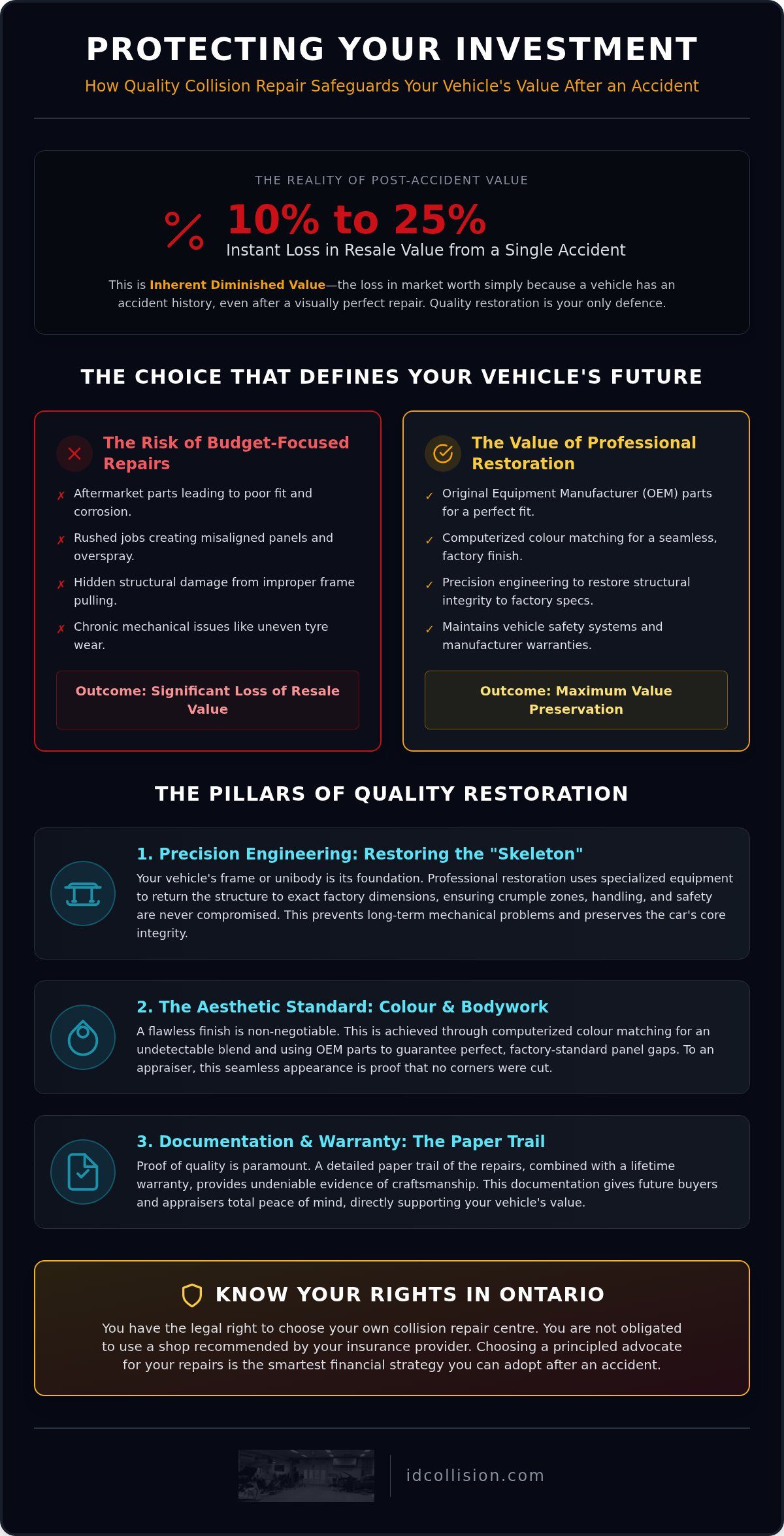
Did you know that a single accident can instantly strip 10% to 25% of your vehicle’s resale value, even after the metal is straightened and the paint is dry? It’s a stressful realization, especially when you’re trying to understand how quality collision repair protects vehicle value in a market that scrutinizes every accident record. You’ve worked hard for your car, and the pressure from insurance providers to use budget-focused shops only adds to the fear that your investment will never truly recover. We know you want your vehicle to look and drive like new, without the shadow of diminished value hanging over your future trade-in.
This article explores how professional restoration safeguards your automotive investment and prevents permanent depreciation. You’ll learn why certified craftsmanship is your best defence against hidden structural damage and how a verified repair history provides total peace of mind. We’ll walk through the technical standards required to maintain your car’s integrity and why choosing a principled advocate for your repairs is the smartest financial strategy you can adopt after an accident.
Key Takeaways
- Understand the financial impact of inherent diminished value and how professional restoration prevents your vehicle from becoming a liability at trade-in.
- Learn why restoring the “skeleton” of your car through precision engineering is the only way to ensure long-term structural integrity and safety.
- Discover how quality collision repair protects vehicle value by utilizing computerized colour matching and factory-standard panel replacement for a seamless finish.
- See how maintaining a detailed paper trail and a lifetime warranty provides the ultimate proof of craftsmanship for future buyers or appraisers.
- Realize your legal right in Ontario to choose your own repair centre, ensuring you don’t have to settle for insurance-mandated shortcuts or economy shops.
The Financial Reality of Post-Accident Vehicle Value
The moments following a collision are chaotic. You’re dealing with police reports, insurance claims, and the logistical headache of being without a car. However, the choices you make in these first 48 hours are the most critical for your bank account. This is when the financial future of your vehicle is decided. If you allow an insurance company to steer you toward a budget-focused shop, you might be trading a lower deductible for thousands of dollars in lost resale value later. Your car is likely one of your largest investments, and protecting that asset requires a strategy of restoration rather than just a quick fix.
Defining Inherent Diminished Value
Even if your car is restored to its original appearance, it often suffers from diminished value. This is the loss in market worth simply because the vehicle has an accident history. In the Canadian market, reports like CARFAX make this history transparent to every future buyer. If you choose a shop that takes shortcuts, the gap between pre-accident and post-repair value widens. Understanding how quality collision repair protects vehicle value starts with recognizing that precision work minimizes these red flags on history reports. High-standard repairs prove to future appraisers that the vehicle’s integrity was never compromised. When a report shows a collision followed by a high-tier restoration, it tells a story of meticulous care rather than neglect.
Market Perception vs. Reality
A shiny coat of paint can hide a multitude of sins, but professional appraisers are trained to see past the surface. They look for specific “artifacts” of a rushed job that signal hidden trouble. These include misaligned body panels, uneven gaps, or overspray on rubber seals and wheel wells. If a buyer or dealership sees these signs, they immediately suspect structural issues. This triggers a psychological red flag that often leads to a refused trade-in or a significantly lower offer.
Private buyers are often even more skeptical than dealerships. They fear hidden damage more than anything else. When they see a door that doesn’t quite sit flush or a slight mismatch in paint texture, they will likely walk away. This is how quality collision repair protects vehicle value; it removes the doubt. By using computerized colour matching and factory-standard panel replacement, you ensure the car doesn’t just look good in a photo. It stands up to a physical inspection from a professional who knows exactly where to look for flaws. True restoration means returning the car to factory-spec “pre-collision” condition, ensuring the vehicle’s skeleton is as sound as the day it was built.
Precision Engineering: Restoring Structural Integrity and Safety
Think of your vehicle’s frame or unibody as its skeleton. If the bones are crooked, the rest of the body simply cannot function as intended. When a car sustains structural damage, some shops attempt to “pull” or straighten the metal to save on costs. However, modern automotive steel is engineered with specific crumple zones and strength ratings that can be compromised if manipulated too many times. A vehicle that hasn’t been restored to factory dimensions will suffer from chronic mechanical issues, such as uneven tyre wear and poor handling. This is fundamentally how quality collision repair protects vehicle value; it ensures the foundation of the car remains as safe and reliable as it was on the showroom floor.
Ensuring this level of precision requires specialized equipment and a commitment to doing things right the first time. If you’re concerned about the long-term impact on your investment, focusing on recovering lost value starts with a shop that refuses to take shortcuts with your safety. You can always ask for a free estimate to understand exactly how a structural restoration should be handled.
OEM Parts vs. Aftermarket Alternatives
Original Equipment Manufacturer (OEM) parts are the gold standard because they are identical to the components your car was built with. Budget-focused shops often use aftermarket panels that might be slightly thinner or lack the same corrosion protection. These “economy” parts frequently result in poor fit and finish, leaving uneven gaps between doors or fenders. To a professional appraiser, these gaps are a neon sign that the car was repaired on the cheap. Using OEM parts not only ensures a perfect look but also maintains your manufacturer’s original corrosion warranty, which is a major selling point for future owners.
The Critical Role of ADAS Calibration
Modern vehicle value is no longer just about metal and paint; it’s about technology. Advanced Driver Assistance Systems (ADAS), including cameras, radar, and blind-spot sensors, are often located behind bumpers and windshields. Even a minor front-end collision can knock these systems out of alignment. If these sensors aren’t meticulously recalibrated, your safety features may fail or trigger persistent error codes on the dashboard. Nothing destroys trade-in value faster than a “system error” light. A quality-first shop treats these electronic systems with the same precision as the bodywork, ensuring your car’s sophisticated safety tech works perfectly when you need it most.
The Aesthetic Standard: Colour Matching and Seamless Bodywork
Visual appeal is often the first and most powerful metric used during a vehicle appraisal. If a prospective buyer or a dealership trade-in manager notices a slight variation in the shade of a door compared to the rest of the car, the value drops instantly. This isn’t just about vanity; it’s about the perceived quality of the entire repair. A car that looks “off” suggests that shortcuts were taken elsewhere too. Ensuring a flawless finish is how quality collision repair protects vehicle value by maintaining the aesthetic integrity that high-value domestic and import cars require.
Achieving this level of perfection requires more than a good eye. It demands a controlled environment. Professional paint booths are designed to eliminate dust and airborne contaminants that cause “nibs” or imperfections in the clear coat. Beyond cleanliness, the texture of the paint must match. Every factory finish has a specific “orange peel” texture. If the repaired panel is too smooth or too textured, it stands out like a sore thumb. A principled advocate for your vehicle’s value will ensure that the gloss, texture, and edge-to-edge consistency are indistinguishable from the original factory work.
Advanced Colour Matching Technology
The science behind modern paint is incredibly complex. Technicians use spectrophotometers to analyze the exact pigment breakdown of your car’s specific finish, accounting for age and sun exposure. “Close enough” is a phrase that has no place in a quality shop. To ensure a truly invisible repair, technicians must master the art of “blending” paint into adjacent panels. This technique avoids hard lines and tricks the eye into seeing a continuous, uniform colour across the entire side of the vehicle. Investing in professional automotive refinishing Kingston is the only way to guarantee your car doesn’t lose its lustre or its market worth after an accident.
Paintless Dent Repair (PDR) for Minor Damage
Sometimes, the best way to protect value is to not use paint at all. For minor dings, creases, or hail damage, Paintless Dent Repair (PDR) is often the superior choice. This specialized process uses precision tools to gently massage the metal back into its original shape from behind the panel. Because it keeps your original factory paint intact, it preserves the most valuable part of your car’s exterior. It also eliminates the need for heavy body fillers that can crack or shrink over time. Utilizing paintless dent repair Kingston for small imperfections ensures your car’s history remains as clean as its appearance, providing an invisible restoration that appraisers love to see.
Documentation and Warranty: The Paper Trail of Quality
When you eventually decide to sell or trade in your vehicle, the buyer will undoubtedly scrutinize its history. If they see a collision record without a corresponding stack of professional paperwork, they’ll likely assume the worst. They might imagine bent frames, structural compromises, or mismatched paint hidden just beneath the surface. This is where your repair file becomes your most powerful negotiation tool. It transforms a “damaged” car into a “meticulously restored” asset in the eyes of an appraiser or a private buyer. Understanding how quality collision repair protects vehicle value requires looking beyond the physical car and focusing on the evidence of its restoration.
A professional body shop acts as your financial guardian during this process. By providing transparent, line-item estimates and final invoices, they give you the data needed to prove the car was restored without compromise. When a potential buyer tries to cite the accident as a reason for a low-ball offer, you can present a document showing exactly what was replaced and how it meets factory standards. This shifts the conversation from “what’s wrong with the car” to “look how well this car was maintained.” If you want to ensure your car’s history is a selling point rather than a liability, you can book a free estimate to start your restoration on the right foot.
The Security of a Lifetime Warranty
A lifetime warranty on workmanship is the ultimate proof of value protection. It tells a future owner that the shop stands behind every weld, every bolt, and every coat of clear coat for as long as the car is on the road. Fly-by-night shops or “economy” centres often refuse to guarantee their work beyond a few months, which essentially devalues your vehicle the moment you drive off the lot. A standing warranty proves the shop’s confidence in their craftsmanship. It provides a level of empathetic reassurance to the next owner, knowing that if a door handle ever sticks or a seam leaks, the original repairer is accountable. This confidence is a massive selling point that justifies a higher market price.
Creating a Comprehensive Repair File
To build a solid case for a higher resale price, you need to maintain a disciplined paper trail. A comprehensive repair file should be more than just a single receipt shoved into the glove box. It should tell the story of a “no expense spared” restoration. We recommend collecting the following items for your records:
- High-resolution photos of the “before,” “during,” and “after” repair stages to show the depth of the work.
- A final invoice that clearly lists Original Equipment Manufacturer (OEM) part numbers.
- Documentation of computerized colour matching and ADAS sensor recalibration.
- A copy of the shop’s lifetime workmanship warranty.
Seeing the care taken during the teardown and the use of genuine parts provides tangible evidence of quality that a CARFAX report alone cannot convey. This file effectively counters the psychological impact of an accident history by proving that the vehicle’s integrity was never sacrificed for a cheaper repair.
Choosing the Right Ally: Why Your Choice of Shop Matters in Ontario
You might feel a heavy sense of pressure the moment you call your insurance provider to report a claim. They often suggest a “preferred” shop, implying it’s the easiest or only path forward for your repairs. However, in Ontario, you have the absolute legal right to choose your own collision repair centre. This choice is the most significant factor in how quality collision repair protects vehicle value. An insurance-preferred “economy” shop often operates on a high-volume, low-cost model where their primary client is the insurance company, not you. By choosing a shop that prioritizes your car’s long-term integrity over the insurer’s bottom line, you’re making a calculated financial decision to safeguard your resale value.
Selecting a local expert means choosing a partner who values your safety and your car’s market worth as much as you do. This isn’t just about getting the car back on the road. It’s about ensuring that the restoration is so precise that a future appraiser cannot find a single reason to devalue your trade-in. When you choose an independent shop with a reputation for excellence, you’re opting for a level of craftsmanship that a high-volume “preferred” shop simply cannot match.
Know Your Rights: Insurance Steering
Insurance steering happens when a provider uses subtle or direct pressure to move your vehicle toward their partner network. While these shops are convenient for the insurer, they are often incentivized to use recycled parts or skip time-consuming recalibrations to keep costs low. Standing your ground for high-tier collision repair Kingston Ontario ensures that your vehicle receives the attention it deserves. You have the right to demand parts and processes that meet factory standards, regardless of what an insurance adjuster might suggest. Being an informed consumer is your first line of defence against permanent vehicle depreciation.
The ID Collision Difference in Kingston
At ID Collision, we see ourselves as your principled advocate. We don’t just aim for a car that is “drivable”; we restore it to its exact pre-accident condition. This means we handle the heavy lifting of insurance claims and negotiations for our neighbours, ensuring that no shortcuts are taken with your investment. We live and work in the Kingston community, and our local accountability means we stand behind every weld and every coat of paint with a lifetime warranty. We treat every vehicle as if it were our own, focusing on the details that maintain its structural and aesthetic value for years to come.
Before you commit to a repair, use this final checklist to ensure you’ve chosen a shop that truly protects your value:
- Lifetime Warranty: Do they offer a written guarantee on all workmanship?
- OEM Commitment: Will they fight for Original Equipment Manufacturer parts over aftermarket alternatives?
- Technical Precision: Do they have the equipment to perform full ADAS recalibrations?
- Documented Integrity: Will they provide the detailed repair file you need for future resale?
By choosing the right ally, you turn a stressful accident into a narrative of professional restoration. This ensures that when you finally hand over the keys to a new owner, you can do so with total confidence and your vehicle’s value fully intact.
Secure Your Vehicle’s Future Restoration
Restoring your car after an accident is about more than aesthetics; it’s a focused financial strategy. By prioritizing structural precision and insisting on expert colour matching for your import or domestic vehicle, you actively prevent the permanent depreciation that follows a subpar repair. A documented history, backed by a lifetime warranty on all workmanship, serves as your ultimate proof of quality when it’s time to sell or trade in your asset. This proactive approach is exactly how quality collision repair protects vehicle value over the long term, turning a stressful event into a narrative of professional care.
At ID Collision, we act as your principled advocate, providing direct insurance company billing and the specialized craftsmanship your car deserves. We take the burden of the repair process off your shoulders so you can focus on getting back to your normal routine. Request Your Free Collision Repair Estimate in Kingston Today. You don’t have to navigate the aftermath of an accident alone; let us help you restore your peace of mind and your vehicle’s integrity.
Frequently Asked Questions
Does a car accident always lower the resale value of my vehicle?
Yes, an accident history almost always results in some level of inherent diminished value. Even after a car is perfectly restored, its market worth is typically lower than an identical vehicle with a clean history. This is why understanding how quality collision repair protects vehicle value is so important; while you can’t erase the accident, you can minimize the financial gap by proving the restoration was performed to factory standards.
Will insurance pay for the diminished value of my car in Ontario?
Generally, standard auto insurance policies in Ontario do not cover diminished value claims. Your insurer is legally obligated to restore your vehicle to its pre-accident condition, but they aren’t required to compensate you for the loss in market resale value. This makes choosing a high-tier repair shop even more critical, as the quality of the workmanship is your only real defence against a significant drop in trade-in worth.
Why are OEM parts better for my car’s resale value than aftermarket parts?
Original Equipment Manufacturer (OEM) parts are the gold standard because they are identical to the components used when your car was first built. They ensure a perfect fit and finish, preventing the uneven gaps that signal a cheap repair to appraisers. Using OEM parts also helps maintain your manufacturer’s original corrosion warranty, which is a significant selling point that protects your vehicle’s long-term resale potential.
Can a buyer tell if my car has been in a collision if the repair is high quality?
A professional appraiser or a trained mechanic can often find signs of a repair, but a high-quality restoration makes those signs nearly invisible to the average buyer. By utilizing computerized colour matching and factory-spec panel alignment, a quality shop ensures the car looks and drives like new. When the work is seamless, the accident history on a report becomes much less of a deterrent to potential purchasers.
What is the most important document to keep after a collision repair?
The most critical document is your final itemized invoice that clearly lists the use of OEM parts and a detailed breakdown of the work performed. This document, paired with your lifetime workmanship warranty, provides tangible evidence of a “no expense spared” restoration. Keeping this file allows you to justify a higher asking price by proving that the vehicle’s structural and aesthetic integrity was fully restored.
Is it better to pay for a minor dent repair out of pocket to avoid an accident report?
Paying out of pocket for minor repairs, like small door dings or bumper scuffs, can sometimes protect your vehicle’s history report if the damage is below the legal reporting threshold. In Ontario, the property damage threshold for a mandatory police report increased to $5,000 in July 2026. If the damage is purely cosmetic, using Paintless Dent Repair (PDR) out of pocket can be a smart way to keep your car’s record clean and preserve its value.
How does a lifetime warranty on repairs help when I sell my car?
A lifetime warranty acts as a powerful trust signal for future owners. It demonstrates that the shop has absolute confidence in their craftsmanship and that the repair is permanent. When you show a buyer that the restoration is guaranteed for as long as the car is on the road, it removes the fear of hidden issues or future paint failure, making how quality collision repair protects vehicle value a central part of your sales pitch.
Why should I choose an independent shop over an insurance-recommended one?
Independent shops typically act as your personal advocate, whereas insurance-recommended centres often prioritize the insurer’s cost-cutting goals. A quality-first independent shop will fight for OEM parts and thorough recalibrations that an economy shop might skip. Choosing your own repair centre is your legal right in Ontario and is the best way to ensure your vehicle’s long-term integrity and resale value are the top priorities.