
What if the most dangerous consequence of your recent collision is the damage you cannot actually see? After an impact, it is common to focus on the visible dents or scratched paint, but the real threat often lies beneath the surface. You might be worried about whether your car is truly safe to drive or if hidden repair costs will spiral out of control. Learning how to check for frame damage after accident is the most important step you can take to protect your family and your investment.
We understand that managing the aftermath of a crash is stressful, and you deserve to feel confident in your vehicle’s structural integrity. This guide will help you identify the subtle red flags of a compromised frame so you can make informed decisions about your repairs. We will provide a clear checklist of signs to look for, explain the vital difference between cosmetic and structural damage, and help you realize when it is time to consult a professional for a precision 3D assessment to ensure your car is restored correctly.
Key Takeaways
- Understand why structural damage is often invisible and how modern unibody construction reacts differently to impacts compared to traditional frames.
- Learn how to check for frame damage after accident by identifying visual cues like misaligned body panels, sticking latches, or uneven gaps in the vehicle’s exterior.
- Discover how professional 3D measuring technology identifies microscopic misalignments that a manual inspection simply cannot detect.
- Recognize your rights as an Ontario driver to choose your own collision centre to ensure your vehicle is restored to factory safety standards.
- Protect your vehicle’s resale value and long-term safety by addressing hidden structural issues before they lead to mechanical failure or compromised crash protection.
Why Frame Damage is the Hidden Danger of Car Accidents
Vehicle frame damage is any compromise to the structural core of your car. It is the backbone of your vehicle; it supports the weight of the engine, keeps the wheels aligned, and protects you during a crash. In the past, most vehicles used heavy steel beams, but modern automotive design has shifted toward sophisticated Unibody vs. Body-on-Frame constructions. This shift has made cars lighter and more fuel-efficient, but it also means that structural damage is harder to see with the naked eye.
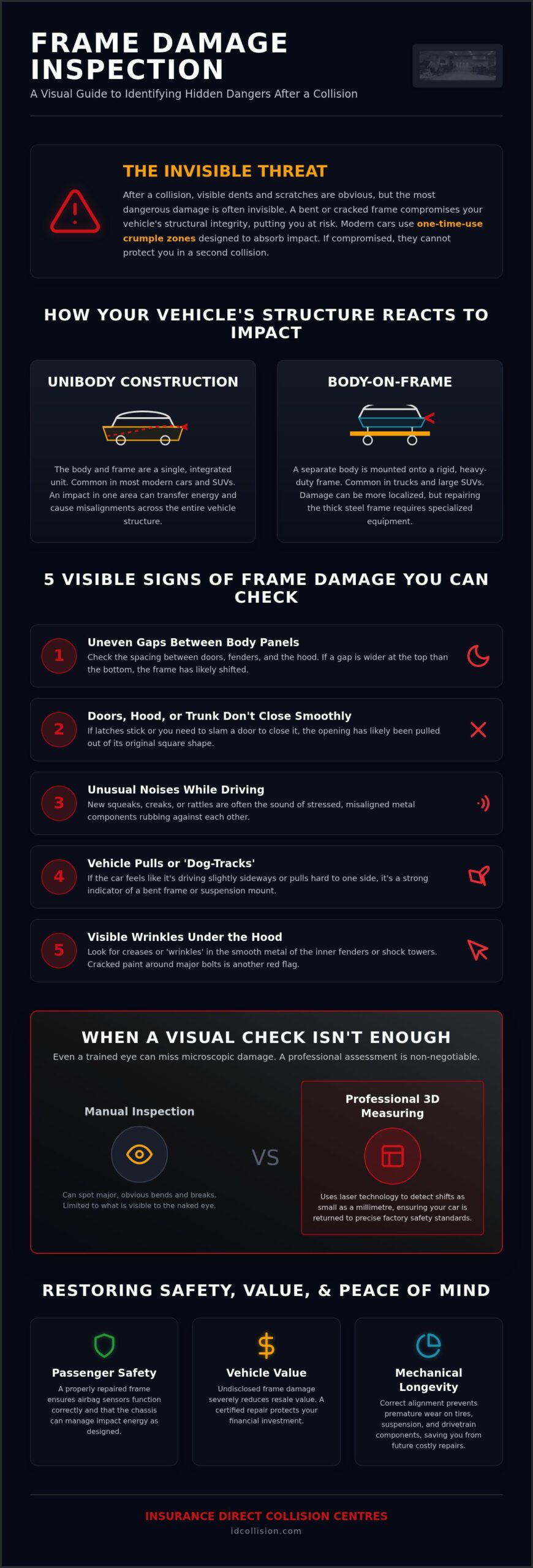
The real danger lies in the “hidden” nature of these issues. While a dented door or a scratched bumper is obvious, the underlying metal can be bent or cracked without showing any external signs. Understanding how to check for frame damage after accident is vital because modern cars utilize crumple zones. These areas are engineered to sacrifice themselves by deforming to absorb impact energy. Because they are one-time-use components, a compromised crumple zone cannot protect you in a second collision. It leaves you and your passengers vulnerable.
The Role of the Chassis in Passenger Safety
Your vehicle’s chassis is its primary safety system. It is designed to manage and redirect impact energy away from the cabin during a collision. If the frame is even slightly out of alignment, this energy management system fails. This misalignment can also interfere with your car’s computer systems. Airbag sensors rely on specific deceleration rates to trigger; a bent frame changes how the car vibrates and slows down during a hit, which can delay airbag deployment. Additionally, the structural integrity of the pillars and frame is what maintains roof strength during a rollover. If the skeleton is weak, the cabin is more likely to collapse.
Minor Impacts vs. Major Structural Shifts
Many drivers assume that a low-speed “fender bender” at 15 km/h cannot cause structural issues. This is a dangerous misconception. Even at low speeds, the force of an impact must go somewhere. This energy often creates a domino effect; it travels through the bumper reinforcements and into the vehicle floor, potentially buckling the metal in areas you would never think to look. A unibody frame is the integrated skeleton of the vehicle where the chassis and body panels are manufactured as a single, cohesive unit. Because everything is connected, a hit to the rear corner can actually cause a shift in the front alignment. Knowing how to check for frame damage after accident ensures you don’t overlook these subtle but serious shifts in your car’s foundation.
5 Visible Signs of Frame Damage You Can Check at Home
You don’t need to be a licensed technician to spot the early warning signs of a bent chassis. After a collision, your first step should be a slow, methodical walk-around of the vehicle on level ground. Knowing how to check for frame damage after accident starts with looking for “crookedness” from a distance. Does the car seem to lean to one side? Do the wheels look like they are sitting at odd angles within the wheel wells? These subtle visual cues often point to a significant shift in the vehicle’s underlying geometry.
Pay close attention to how the car sounds when you drive it. New squeaks, creaks, or metallic rattles that weren’t there before the impact are often the sound of stressed metal components rubbing together. These noises frequently occur because the frame has shifted just enough to put components out of their original alignment. If the car feels like it’s “dog-tracking” (driving slightly sideways) or pulling hard to one side, the structural core is likely compromised.
The “Gap Test” for Body Panels
One of the most reliable ways to identify structural issues is by examining the gaps between your body panels. Use a simple ruler or even your fingers to check the spacing between the doors and the fenders, or the hood and the grille. Consistent spacing is the hallmark of a straight frame. If you find a gap that is wide at the top and narrow at the bottom, the frame has likely buckled. Similarly, if one door requires extra force to close or if the trunk latch sticks, the opening itself has probably been pulled out of square. These fitment issues are rarely just cosmetic; they are symptoms of a deeper problem.
Under-the-Hood Visual Inspection
Open the hood and look closely at the inner fenders and shock towers. You are looking for “wrinkles” or creases in the metal that should be smooth. Check the structural bolts that hold the engine cradle and frame components together. If you see cracked or flaking paint around these bolts, it’s a sign that the metal has stretched or twisted under the force of the impact. While home checks are helpful, The Professional Inspection Process used by safety investigators proves that many structural failures remain invisible without specialized equipment. If you notice any of these red flags, a thorough assessment at a qualified collision repair centre is the best way to ensure your vehicle remains safe for your family.
Don’t ignore your tires during this inspection. If you’ve been driving for a few days after the accident and notice the tread is wearing prematurely on only one side, your vehicle’s geometry has shifted. This uneven wear is a classic sign that the frame is no longer holding the wheels in their factory-specified positions. It’s a safety risk that can lead to a blowout or loss of control in wet weather.
Unibody vs. Body-on-Frame: Why Your Vehicle Type Matters
Modern vehicles are not all built the same. If you drive a heavy-duty truck or an older SUV, you likely have a body-on-frame construction. This design means the body of the car sits on top of a separate, rigid steel frame. In contrast, almost all modern sedans, hatchbacks, and crossovers use unibody construction. In a unibody car, the frame and body are manufactured as one integrated piece. This design is safer and more fuel-efficient, but it completely changes how to check for frame damage after accident because the impact energy travels through the entire shell rather than just a single rail.
Repair techniques differ significantly between these two types. Body-on-frame vehicles often allow for the replacement of specific sections of the frame. Unibody vehicles, however, require a more holistic approach. Because the entire car acts as a structural unit, a hit to the rear bumper can actually cause a roof pillar to move. This is why unibody repairs require specialized computerized measuring systems to ensure every point of the vehicle returns to its factory-specified location.
The Precision of Modern Unibody Repair
Unibody frames are engineered with what technicians call “memory.” When the metal is bent during a collision, its molecular structure is compromised. Attempting to “pull” a unibody frame back to its original shape without precise factory data is dangerous. You cannot simply eyeball these repairs. Modern shops use 3D measuring systems that compare your car’s current state against original blueprints. This level of accuracy is essential; even a three-millimetre deviation can prevent your advanced safety sensors from working correctly. To learn more about these rigorous standards, you can read about Professional Collision Repair in Kingston to understand why precision is non-negotiable for your safety.
Truck and SUV Frame Considerations
Heavy-duty trucks present a different set of challenges. Their frames are made of thick, high-strength steel that can hide stress fractures behind other components. While you might look for Visible Signs of Frame Damage like buckled metal or cracked welds, trucks often suffer from “diamond” or “twist” damage. This occurs when one side of the frame is pushed forward or backward relative to the other. You might not see a single dent on the exterior, yet the vehicle is structurally unsound. Knowing how to check for frame damage after accident for a truck involves looking at the geometry of the entire chassis.
- Check for “dog-tracking,” where the rear wheels do not follow the front wheels in a straight line while driving.
- Look for a steering wheel that is off-centre when the tires are pointed straight.
- Monitor for rapid or unusual tire wear, as a twisted frame often manifests first through wheel alignment issues.
The Professional Inspection Process: What Happens at the Body Shop
While the visual checks you perform at home are a vital first step, they only reveal part of the story. A professional assessment is necessary because modern automotive engineering hides complex structures behind plastic covers and aerodynamic shields. When you bring your vehicle to a specialized facility, the team follows a rigorous, multi-step protocol to identify every microscopic flaw. Understanding how to check for frame damage after accident at a professional level involves moving beyond what is visible to the naked eye and using technology that speaks the same language as the factory that built your car.
The process typically begins with a preliminary visual scan, followed by the systematic removal of cosmetic components. By stripping away bumpers, grilles, and rocker panels, technicians can inspect the “skeleton” of the vehicle directly. They look for stress fractures, pulled welds, and signs of metal fatigue that are otherwise buried. They also pay close attention to suspension mounting points. Even a millimetre-level shift where the suspension meets the frame can lead to dangerous handling issues or premature tire wear. Finally, the shop compiles these findings into a comprehensive report. This document is essential for your insurance claim, ensuring that all necessary repairs are authorized and documented for your vehicle’s history.
Advanced 3D Measuring Systems
Laser-guided measuring systems are the most important tools in a modern body shop. These systems use high-precision sensors to map out the underside of your vehicle, creating a digital twin that is compared against original factory blueprints. Computerized 3D measuring systems can detect frame misalignments as small as one millimetre. This level of detail is critical because factory specifications are the only acceptable “straight” standard for a safe vehicle. If the measurements don’t match the blueprints exactly, the structural integrity of the car is considered compromised. These systems provide an objective, data-driven foundation for the entire repair process.
The Importance of Post-Repair Wheel Alignment
Once the frame has been restored, a final check is required to ensure everything is back in its proper place. A straight frame is the foundation upon which your entire steering and suspension system sits. If the foundation is off, the wheels will never track correctly, no matter how many times you adjust the parts. This is why a specialized Wheel Alignment in Kingston is the final step in any structural restoration. It confirms that the frame, suspension, and steering are working in perfect harmony. This step provides the peace of mind that your car handles exactly as it should during emergency manoeuvres.
If you suspect your vehicle’s structure has been compromised, don’t leave your safety to chance. You can book a professional frame inspection today to receive a definitive answer and a clear path toward restoration.
Restoring Safety and Value: Why Expert Repair is Non-Negotiable
Repairing a vehicle’s structure is about more than just making it look straight; it is about restoring the complex safety systems that protect you and your family. While you now know how to check for frame damage after accident, the final step is ensuring that any identified issues are corrected to original manufacturer standards. A vehicle with a compromised frame is not only less safe in a second collision, but it also suffers from a significant drop in market value. Professional restoration ensures that your car remains a reliable asset rather than a liability.
We believe in being a principled advocate for our customers. This means standing between you and the complexities of the insurance process to ensure no shortcuts are taken with your vehicle’s structural integrity. A lifetime warranty on workmanship is a standard you should expect from any reputable facility. It provides the peace of mind that your car has been restored with precision and that the shop stands behind every weld and alignment point for as long as you own the vehicle.
Protecting Your Investment and Resale Value
When the time comes to sell or trade in your vehicle, a “clean” structural report is vital. Potential buyers and dealerships use history reports to identify previous accidents; if those reports show unrepaired or poorly repaired structural damage, your resale value will plummet. Professional restoration involves more than just pulling metal. It requires Expert Automotive Refinishing in Kingston to ensure that the repair is invisible to the eye while the underlying structure is returned to factory strength. This holistic approach preserves the longevity of your car and protects your financial investment.
Your Rights as an Ontario Driver
Many drivers feel pressured by their insurance providers to use a specific “preferred” repair facility. It is important to remember that in Ontario, you have the legal right to choose your own collision centre. Your insurance company cannot force you to go elsewhere. Choosing a local expert who understands the specific driving conditions in Kingston, Gananoque, and Napanee ensures you receive personalized service from neighbours who are accountable to their community. We coordinate directly with your insurance company to handle the paperwork, allowing you to focus on getting your life back to normal after a stressful event.
Beyond the mechanical repairs, some accidents can result in complicated legal situations that require professional advocacy. For those navigating serious legal challenges following an incident, you can visit Law Office of Kevin Bessant & Associates to discover how expert representation can help protect your future.
Structural integrity is the foundation of vehicle safety. If you have any doubt about the condition of your chassis, do not wait for a mechanical failure to occur. Contact ID Collision for a professional frame inspection today. Our team will provide the transparent, expert guidance you need to get back on the road with total confidence.
Take the Next Step Toward Total Peace of Mind
Your vehicle’s structural integrity is too important to leave to guesswork. While identifying uneven panel gaps or listening for unusual noises is a great start when learning how to check for frame damage after accident, these visual cues are often just the surface of the story. True safety depends on returning your car’s skeleton to its exact factory blueprints. This precision ensures that your crumple zones are ready for the future and your advanced safety sensors function exactly as they were intended to.
We are here to act as your advocate throughout the entire restoration process. Our team utilizes advanced 3D measuring technology to catch misalignments that are invisible to the naked eye; additionally, we handle direct coordination with insurance companies to take the administrative burden off your shoulders. With a lifetime warranty on all structural repairs, you can drive away knowing your investment is protected. Book your free structural damage estimate at ID Collision Kingston today. You deserve to feel confident in a vehicle that is as safe as the day you first drove it home.
Frequently Asked Questions
Can a car with frame damage be safely repaired?
Yes, most frame damage can be safely repaired if the collision centre utilizes computerized 3D measuring and follows strict factory procedures. Modern unibody vehicles are engineered to have specific structural components replaced or straightened to restore their original crashworthiness. If the metal’s molecular integrity is maintained during the process, the vehicle’s safety remains intact. However, if the damage is too extensive to meet safety standards, the car may be declared a total loss.
How much does it cost to fix a bent car frame in Ontario?
The cost to repair a bent frame depends entirely on the severity of the shift and the specific parts required for replacement. Minor misalignments that only require time on a measuring bench will cost less than major structural overhauls involving extensive labour and new components. Because every collision is different, a professional estimate is the only accurate way to determine the specific costs involved for your vehicle’s unique situation.
Will my car be the same after frame repair?
A vehicle will perform exactly as it did before the collision if the repair is completed to factory specifications. By using precision measuring systems to realign the chassis, technicians ensure that the suspension geometry and safety sensors are perfectly calibrated. When an expert performs the restoration and offers a lifetime warranty, you can trust that the vehicle’s handling, tire wear, and safety systems will remain uncompromised for years to come.
Does frame damage always show up on a vehicle history report?
Structural damage typically appears on a vehicle history report if an insurance claim was processed or if the repair facility reports its data to third-party providers. However, these reports are not always perfect or updated in real time. If you are purchasing a used vehicle, it is a smart safety precaution to have a professional show you how to check for frame damage after accident to verify the car’s actual structural condition.
How do I know if my insurance will cover frame repair?
Insurance policies generally cover structural repairs if you have the appropriate collision or all-perils coverage and the repair cost is less than the vehicle’s total value. Your insurer will review the professional estimate to decide if the car is worth repairing or if it should be written off. Choosing a shop that provides direct insurance coordination can make this process much easier for you to navigate while ensuring your rights are protected.
Is it illegal to sell a car with frame damage in Canada?
It is not illegal to sell a car with previous frame damage in Canada, but you are legally obligated to disclose the damage to the buyer. In Ontario, registered dealers must disclose any structural repairs or damage by law. Private sellers should also provide this information in writing to avoid potential legal liability. Transparency is the best way to ensure the next owner understands the vehicle’s history and safety status.
Can a minor fender bender cause frame damage?
Yes, even a low-speed impact can result in significant structural shifts. Modern cars are designed with crumple zones that absorb energy by deforming, which means a 15 km/h hit can buckle internal components even if the bumper looks fine. This is why learning how to check for frame damage after accident is essential for every driver, as even minor collisions can compromise the underlying skeleton of your vehicle.
How long does a professional frame inspection take?
A comprehensive professional frame inspection typically takes between one and three hours to complete. This time allows technicians to remove cosmetic shields, mount the vehicle on a specialized measuring bench, and perform a digital 3D scan. Once the data is compared against original factory blueprints, the shop can provide a detailed report that clearly identifies any structural deviations that need to be addressed to ensure your safety.