
What if that small, raised blister on your door panel is actually a warning that your car’s structural integrity is at risk? It’s an unsettling sight for any vehicle owner, and it’s natural to worry about hidden rust eating through the metal or whether insurance will cover the repair. You’ve likely spent time wondering if a simple touch-up is enough or if a professional car paint bubbling fix cost is a necessary investment to save your vehicle’s resale value.
We understand the stress of seeing your car’s finish deteriorate, especially in Kingston’s harsh, salt-heavy winters. You want a solution that lasts, not a temporary patch that fails by next season. This guide provides a transparent breakdown of the repair process and professional restoration methods. We’ll help you distinguish between minor solvent pops and serious corrosion while setting realistic expectations for labour and materials. By the end of this article, you’ll have a clear path toward a permanent fix that protects your car and your peace of mind.
Key Takeaways
- Identify whether your paint blisters are surface-level solvent pops or structural rust damage before they compromise your vehicle’s safety.
- Learn the “push test” to determine if the metal substrate has softened, indicating a need for immediate professional intervention.
- Gain a clear understanding of the car paint bubbling fix cost in Ontario by evaluating local labour rates and the role of high-quality materials.
- Discover the professional restoration steps required to neutralize corrosion and prevent recurring damage in Kingston’s salt-heavy climate.
- Protect your vehicle’s long-term resale value with expert colour matching and workmanship backed by a lifetime warranty.
What Causes Car Paint Bubbling? Understanding the Root Issue
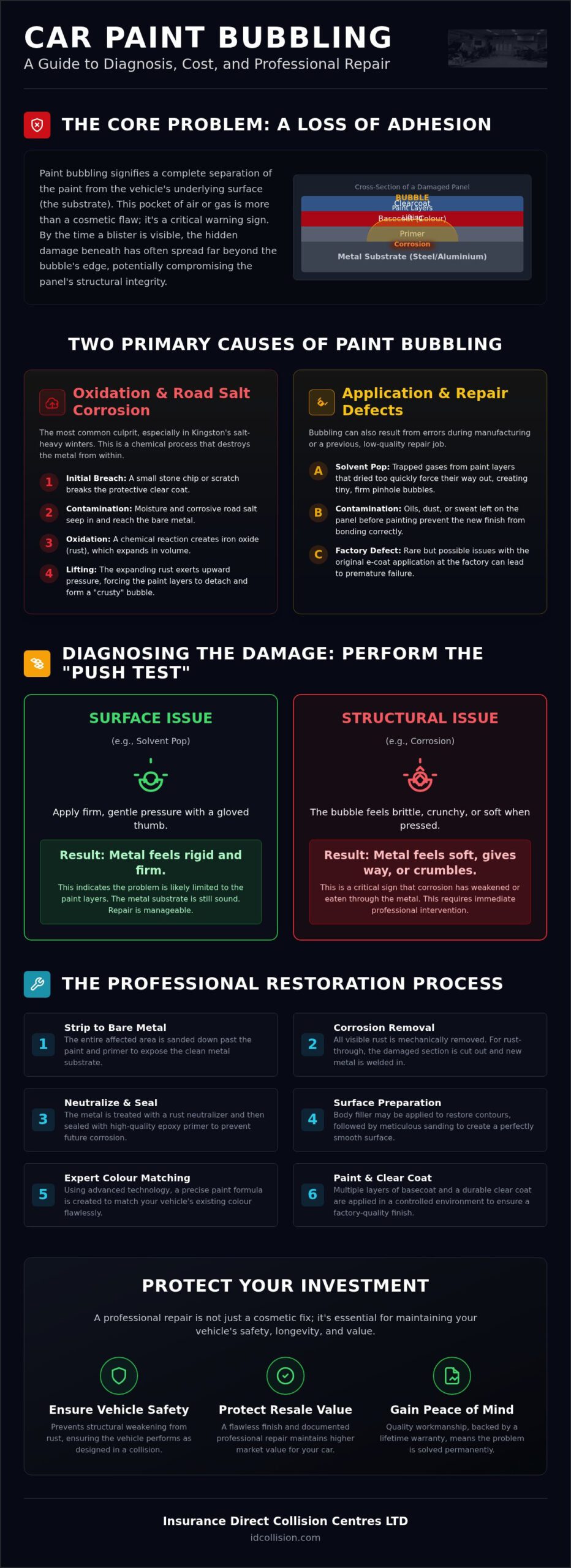
At its core, paint bubbling represents a total loss of adhesion between your vehicle’s paint film and the substrate beneath it. Whether that substrate is steel, aluminium, or plastic, the paint has detached and formed a pocket. While it might look like a minor cosmetic blemish, these blisters are almost always the tip of the iceberg. By the time a bubble becomes visible to the naked eye, the underlying damage has often spread significantly further than the perimeter of the bump. In Kingston, our unique climate and road maintenance habits make this a common but urgent concern for local drivers.
Identifying the root cause is the first step in determining a realistic car paint bubbling fix cost. If the metal underneath is still structurally sound, the repair remains manageable. However, if the bubbling is a symptom of deep-seated oxidation, the restoration process becomes more complex. Understanding why this happens helps you make an informed decision about your vehicle’s longevity and resale value.
The Role of Oxidation and “Road Salt” Corrosion
Kingston winters are notoriously hard on automotive finishes. The process often starts with a tiny, unnoticed stone chip. This break in the clear coat allows moisture and road salt to penetrate the protective layers. Once salt reaches the bare steel, a chemical reaction begins. Steel reacts with oxygen and moisture to create iron oxide, commonly known as rust. This oxidation occupies more physical space than the original metal, which creates upward pressure. This pressure eventually forces the paint to lift and stretch, creating the “crusty” bubbles you see on wheel arches or door bottoms. Because our local roads are heavily treated with de-icing agents, this corrosive cycle accelerates much faster here than in drier or warmer regions.
Manufacturing and Previous Repair Defects
Not every bubble is caused by rust. Sometimes, the issue stems from “solvent pop” or contamination. Solvent pop occurs when the top layer of paint dries too quickly during a repair, trapping gases from the base coat underneath. These gases eventually force their way up, creating tiny pinhole bubbles. Other times, the culprit is simple human error during a previous low-quality repair. If a technician leaves even a trace of oil, sweat, or dust on the panel before painting, the new finish won’t bond correctly. Even on newer models, factory defects in the e-coat application can lead to premature bubbling. Identifying these “dry” bubbles versus “wet” rust bubbles is essential for an accurate car paint bubbling fix cost estimate, as the repair methods for each differ significantly.
Diagnosing Your Damage: Rust Bubbles vs. Solvent Pops
Before you can accurately budget for a car paint bubbling fix cost, you need to know exactly what is happening beneath the surface. Not all bubbles are created equal. Some are merely cosmetic flaws from a previous paint job, while others are the first signs of a terminal rust problem. A “dry” bubble typically feels firm to the touch and appears uniform in size. These are often solvent pops. In contrast, a “crusty” bubble feels brittle or crunchy when pressed and usually has an irregular, jagged shape. This texture is the result of iron oxide expanding and pushing the paint away from the metal.
You can perform a simple “push test” at home to gauge the severity. Using a gloved thumb, apply firm but gentle pressure to the centre of the bubble. If the metal remains rigid, you likely have surface-level issues. If the panel feels soft, gives way, or crumbles, the corrosion has already compromised the metal’s thickness. This distinction is vital; surface issues can often be sanded and refinished, but soft metal usually requires a panel replacement to ensure the vehicle remains safe and roadworthy.
Identifying Rust-Through vs. Surface Rust
The most deceptive bubbles are those that start on the backside of a panel. This is common on wheel wells and rocker panels where road salt accumulates in hidden crevices. By the time you see a bubble on the exterior, the rust may have already eaten entirely through the steel. Surface rust is a manageable fix that involves removing the oxidation and resealing the metal. However, rust-through damage requires cutting out the affected area and welding in new metal or replacing the entire component. Ignoring these signs on structural areas like pillars or sills can lead to significant safety risks during a collision, as the weakened metal cannot manage impact forces as designed.
Spotting Paint Application Errors
If you notice clusters of tiny pinholes or bubbles that seem to follow a specific pattern, you might be looking at “mapping” or solvent entrapment. This happens when a previous repair was rushed and the paint wasn’t allowed to dry properly between coats. These errors often appear along sanding marks or in areas where the filler was applied too thickly. Correcting these mistakes requires a high standard of automotive refinishing in Kingston to ensure the new layers bond permanently. If you are unsure about the health of your vehicle’s finish, a professional assessment is the most reliable way to prevent a small blemish from becoming a structural failure.
Estimating the Car Paint Bubbling Fix Cost in Ontario
Understanding the car paint bubbling fix cost requires looking past the surface of the bubble itself. In Ontario, the primary driver of any professional auto body bill is the highly skilled labour required to ensure a permanent restoration. Unlike a quick DIY patch, a professional repair involves hours of meticulous preparation. This includes stripping the affected area, neutralizing underlying oxidation, and rebuilding the surface. When you’re quoted for a repair, you’re paying for a technician’s expertise in preventing that bubble from returning after the first winter thaw.
High-quality materials also play a significant role in the final investment. Professional-grade primers, base coats, and UV-resistant clear coats are designed to withstand Kingston’s temperature swings and corrosive road salt. While cheaper materials exist, they often lack the durability to protect the substrate long-term. Additionally, a single bubble on a door usually necessitates painting the entire panel. Spot repairs often leave visible edges or “halos” that diminish your vehicle’s resale value. To achieve an invisible finish, the new paint must be blended into adjacent panels, ensuring the colour match is flawless under all lighting conditions.
Factors That Increase the Final Bill
Specialty finishes, such as tri-coat pearls or modern matte paints, require additional layers and complex blending techniques. These finishes increase both material usage and the time spent in the paint booth. Disassembly is another crucial factor. To avoid unsightly tape lines, a quality shop will remove door handles, trim pieces, and light assemblies before any paint is applied. While this adds to the labour hours, it’s the only way to ensure a factory-standard edge. Finally, the condition of the substrate matters; sanding away surface rust is a straightforward process, but if the metal is compromised, the bill will reflect the need for precision welding or specialized substrate treatment.
Typical Complexity Ranges for Common Repairs
A small surface spot repair is the most economical path, focusing on localized sanding and blending before the rust spreads. Full panel refinishing is the standard for a lasting, invisible fix, especially on high-visibility areas like the hood or roof. In cases where the “push test” reveals soft or perforated metal, a full panel replacement is often the most cost-effective and safest route. At this stage, the labour required to bridge holes with filler often exceeds the price of an OEM-certified replacement part, which provides a more reliable foundation for a finish that lasts as long as you own the car.
The Professional Repair Process: How We Fix It Right
To provide a permanent solution that stops corrosion in its tracks, the restoration process must be methodical. We begin by stripping the affected panel down to the bare substrate. This step is crucial because it reveals the true extent of the damage that was hidden beneath the paint. Once the metal is exposed, we neutralize any remaining oxidation or remove contaminated material. This creates a chemically clean surface, ensuring that the new layers of protection can form a stable, long-term bond with your vehicle’s body.
Investing in a professional car paint bubbling fix cost today prevents the far higher expense of replacing an entire rusted panel later. After the metal is prepared, we apply high-zinc primers or epoxy sealers. These specialized materials act as a heavy-duty barrier against moisture and road salt. We then utilize computerized colour matching technology to formulate a base coat that perfectly aligns with your vehicle’s current shade. This multi-stage application ensures the repair is invisible to the eye and structurally superior to the original factory finish.
Why DIY Paint Repairs Usually Fail
Many owners attempt “rattle can” fixes to save on costs, but these amateur efforts often backfire. Consumer-grade spray paints lack the professional clear coat required for proper UV protection and chemical resistance. Without these, the repair will quickly fade or peel. Even worse, DIY methods often trap microscopic moisture or contaminants under the new paint. This creates a greenhouse effect that accelerates metal rot, making the bubbling return faster and more aggressively than before. Matching the subtle fade of factory paint also requires professional blending techniques that cannot be replicated in a driveway.
Ensuring a Flawless Finish in a Controlled Environment
A professional collision repair in Kingston takes place in a specialized downdraft paint booth. This technology pulls air downward to move dust and overspray away from the vehicle, preventing the surface contamination that causes “solvent pops.” This controlled environment is the only way to achieve a factory-standard finish. The process concludes with a detailing and curing stage that hardens the clear coat for maximum durability. Because we adhere to these rigorous standards, our workmanship is backed by a lifetime warranty for as long as you own the vehicle. If you want to ensure your car’s finish remains flawless, schedule a professional paint inspection with our team today.
Why ID Collision is Your Best Ally for Paint Restoration
Choosing a repair facility involves more than just comparing a car paint bubbling fix cost. It’s about finding a professional who views your vehicle as a long-term investment. At Insurance Direct Collision Centres LTD, we adopt a “Protective Expert” stance. We treat every car with the same precision we’d apply to our own, ensuring your restoration isn’t a temporary patch but a shield for your vehicle’s resale value.
Our team possesses deep expertise in both domestic and import paint systems, allowing us to replicate factory finishes exactly. Because we stand behind our craftsmanship, every repair is backed by the Insurance Direct Collision Centres LTD Lifetime Warranty. This provides security for as long as you own the vehicle. We provide free estimates and straightforward advice. If the substrate damage we discussed earlier makes a repair unfeasible, we’ll be honest with you rather than performing a fix that won’t last.
Navigating Insurance and Your Right to Repair
Many drivers feel pressured by insurers to use “preferred” facilities, but you have the legal right to choose your own shop. We advocate for you by documenting all hidden corrosion to ensure your claim covers the full car paint bubbling fix cost for a proper restoration. This documentation is vital for a successful claim. Learn more about your entitlements in our guide on Choosing Your Own Body Shop in Ontario.
Serving the Kingston, Gananoque, and Napanee Communities
We take pride in our reputation across Kingston and the surrounding regions. Our local accountability means we never take shortcuts that fail after one winter. We understand the specific challenges local drivers face. Book your free paint assessment at Insurance Direct Collision Centres LTD today to secure a path forward for your vehicle.
Restoring Your Vehicle’s Integrity and Value
Addressing paint blisters early is the most effective way to protect your vehicle’s longevity. As we have explored, what looks like a minor blemish is often a sign of deeper metal fatigue that requires specialized intervention. A professional car paint bubbling fix cost ensures that the restoration is permanent, utilizing the zinc-rich primers and controlled environments necessary to withstand Kingston’s corrosive road salts. Taking action now prevents a small surface issue from evolving into a structural failure.
Insurance Direct Collision Centres LTD is committed to maintaining your vehicle’s resale value through precision craftsmanship. Our locally owned and operated shop provides specialized colour matching for all makes and models, and we back all our workmanship with a Lifetime Warranty. You don’t have to navigate the stress of hidden rust alone. Get Your Free Paint Repair Estimate at Insurance Direct Collision Centres LTD today and take the first step toward a flawless, durable finish.
Frequently Asked Questions
Is paint bubbling covered by my car insurance?
Most insurance policies in Ontario exclude paint bubbling because they classify it as wear and tear or environmental degradation. Standard comprehensive coverage doesn’t typically protect against rust or oxidation that occurs over time. However, if the bubbling appeared after a poorly executed collision repair that was part of a previous claim, you might have recourse through the original shop’s warranty or the insurer’s repair guarantee.
Can I just sand down a paint bubble and touch it up myself?
You can sand a bubble at home, but DIY touch-ups rarely provide a permanent fix. Rust often originates from the backside of the metal, meaning surface sanding leaves the root cause untouched. Without professional-grade neutralizing agents and high-zinc primers, the oxidation will likely return within a few months. Trapping moisture under a home repair can actually speed up the corrosion process, ultimately increasing your eventual car paint bubbling fix cost.
How long does it take to fix paint bubbling on a car door?
A professional repair typically takes three to five business days to complete correctly. This timeline allows for the methodical stripping of the panel, neutralizing the metal, and applying multiple layers of primer, base coat, and clear coat. Each layer requires specific curing times in a controlled environment to ensure maximum durability. Rushing this process often leads to poor adhesion and premature failure of the new finish.
Will the new paint match the rest of my car perfectly?
Yes, we achieve a seamless match by using computerized spectrophotometers to analyze your vehicle’s current paint shade. Because factory paint fades over time due to UV exposure, we don’t just use the original colour code. Instead, we formulate a custom tint and use professional blending techniques on adjacent panels. This ensures the transition between the new and old finish is invisible under both sunlight and artificial streetlights.
What happens if I ignore the paint bubbles on my car?
Ignoring bubbles allows moisture and road salt to continue eating through the steel. What starts as a small blister will eventually become a perforation, or a hole, in the metal. Once the metal is perforated, the panel’s structural integrity is compromised, and the repair becomes significantly more expensive. Visible rust can also reduce your vehicle’s resale value by 15% to 30% depending on the severity of the damage.
Does paint bubbling always mean there is rust underneath?
Paint bubbling doesn’t always indicate rust. It can also be caused by solvent pops or adhesion failure from a previous low-quality repair. Solvent pops occur when gases are trapped under the paint during the drying process. While these are cosmetic issues rather than structural ones, they still require professional sanding and refinishing to correct. A push test can help determine if the substrate underneath remains solid or has softened from corrosion.
Is it worth fixing paint bubbles on an older car?
The decision depends on the vehicle’s overall mechanical health and your long-term plans. If the car is structurally sound and you intend to drive it for several more years, fixing the bubbles prevents a small blemish from becoming a major safety issue. However, if the car has significant frame rust or mechanical failures, the car paint bubbling fix cost might exceed the vehicle’s remaining market value or your planned budget.
How can I prevent paint bubbling from happening again?
Prevention starts with regular maintenance and protecting the paint’s surface. Annual rust-proofing treatments are highly effective in Kingston’s salt-heavy environment. You should also wash your car frequently during the winter to remove corrosive de-icing chemicals. Promptly repairing stone chips with a professional touch-up prevents moisture from reaching the bare metal. These proactive steps are the most cost-effective way to maintain your vehicle’s appearance and structural health over time.