
A great auto body repair should be completely invisible; if you can spot where the work was done, the job simply isn’t finished. You’ve already navigated the stress of a collision and the complexities of insurance claims, so the last thing you need is the nagging feeling that your car isn’t quite right. It’s deeply unsettling to pick up your vehicle only to notice a slight colour mismatch or a door that doesn’t close with that familiar, solid thud. You deserve the peace of mind that comes with knowing your vehicle is just as safe and sturdy as it was the day you bought it.
In this guide, we’ll walk you through the critical signs of a bad auto body repair job so you can inspect your vehicle with the eye of a professional. We’ll show you how to identify hidden structural issues and cosmetic shortcuts that could compromise your safety or your car’s future resale value. You’ll gain the confidence to demand a re-repair if the quality falls short and understand your rights under Ontario’s Consumer Protection Act. From checking paint transitions to verifying sensor calibrations, here is how to ensure your car is truly restored to its pre-collision condition.
Key Takeaways
- Master the “Three-Angle Rule” to identify mismatched paint colours and uneven textures that suggest a sub-par cosmetic finish.
- Learn how to look beyond the surface to verify structural integrity and ensure your vehicle’s safety systems are fully restored.
- Gain the knowledge to decode your final invoice and distinguish between high-quality OEM parts and inferior economy alternatives.
- Identify the most common signs of a bad auto body repair job to ensure your vehicle remains safe and maintains its long-term resale value.
- Understand your legal rights in Ontario, including your freedom to choose a repair centre and how to dispute a low-quality insurance-mandated repair.
The Visual “Eye Test”: Spotting Cosmetic Red Flags
The first minute you spend with your vehicle after a repair is often the most revealing. Trust your instincts during this initial walk-around. If something looks “off” immediately, it usually is. A professional automobile repair shop should return your car in a state where you can’t tell it was ever damaged. These early moments are when you’ll catch the most obvious signs of a bad auto body repair job, such as subtle colour shifts or trim pieces that weren’t seated properly.
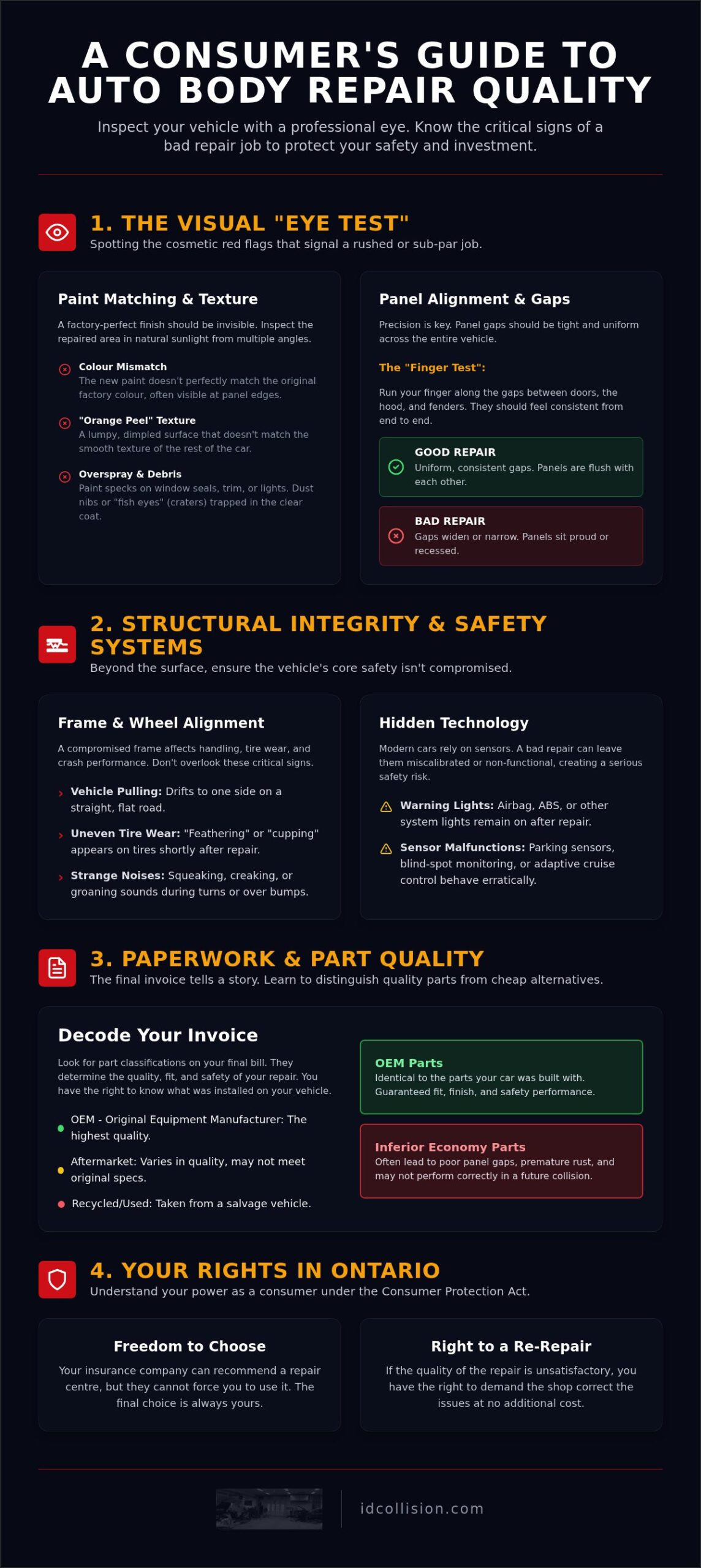
To truly inspect the work, use the “Three-Angle Rule.” Don’t just look at the repaired area straight on. Stand at the front, the back, and then crouch at a 45-degree angle to catch how light reflects across the surface. This technique reveals “waves” in the bodywork or areas where the sanding wasn’t perfectly smooth. Look closely at the edges of the windows and rubber seals. If you see tiny specks of paint or a rough texture on the plastic trim, you’ve found “overspray,” a clear indicator that the shop took shortcuts during the masking process.
Paint Matching and Texture Issues
Achieving a factory finish is a delicate balance of chemistry and skill. If the new paint has a lumpy, dimpled appearance like the skin of a citrus fruit, it’s known as “orange peel.” While some factory finishes have a slight texture, it must match the rest of the car perfectly. Look for “fish eyes,” which are tiny craters caused by contaminants like silicone, or small bumps called “dust nibs” trapped under the clear coat. It’s vital to remember that automotive refinishing Kingston requires precise digital colour matching to be truly invisible. Always check the car in natural sunlight, as the bright LEDs in a shop can sometimes mask a slight mismatch in the paint’s metallic flake or tint.
Panel Misalignment and Gaps
Precision is the hallmark of a quality repair. Use the “finger test” to check the gaps between doors, fenders, and the hood. These spaces should be uniform from top to bottom. If a gap widens or narrows significantly, it suggests the underlying structure might still be tweaked or that a body panel replacement in Kingston was done with inferior aftermarket parts that don’t meet original specifications. Ensure the panels are flush; a panel that sits “proud” against the rest of the body is a major red flag. These alignment issues are common signs of a bad auto body repair job that affect both the look and the aerodynamic seal of your vehicle.
Structural Integrity and Hidden Safety Systems
A car that looks flawless in the driveway can still be a liability on the 401. Safety isn’t skin deep; it’s built into the high-strength steel and complex geometry of your vehicle’s frame. One of the most dangerous signs of a bad auto body repair job is a shop focusing on cosmetic “curb appeal” while ignoring the structural foundation. In some budget-focused facilities, technicians might use “clip-on” repairs or improper sectioning rather than following the manufacturer’s specific structural welding procedures. If these internal components aren’t fused correctly, the vehicle’s “crumple zones” won’t perform as designed in a future accident, putting you and your family at risk.
Modern vehicles are engineered to manage energy during an impact. When a shop cuts corners on frame straightening or uses “recycled” structural components without proper testing, they compromise that engineering. It is vital to Know Your Rights in Auto Repair when it involves your safety. You have the right to demand that your vehicle meets original equipment manufacturer (OEM) standards for structural integrity. If you suspect the shop prioritized speed over safety, don’t hesitate to seek a second opinion before signing off on the work.
Frame and Wheel Alignment
If your vehicle drifts to one side while you’re holding the steering wheel straight, the frame geometry likely hasn’t been fully restored. This “pulling” is a classic red flag. You should also check your tires for unusual wear patterns, such as feathering or cupping, which can appear just days after you pick up the car. A professional wheel alignment in Kingston is a non-negotiable post-collision step. It ensures that the suspension and frame are perfectly synchronized, preventing premature tire failure and maintaining predictable handling during emergency manoeuvres.
The Invisible Tech: Sensors and Airbags
Today’s cars are essentially computers on wheels. Advanced Driver Assistance Systems (ADAS), such as blind-spot monitors and lane-departure warnings, rely on sensors hidden behind bumpers and panels. If these sensors are mounted even a few millimetres off, or if the shop fails to perform a digital calibration, the system may provide false readings or fail to engage when needed. Watch for warning lights on your dashboard or “ghost” alerts from your parking sensors. You also need to ensure the shop used new, certified airbag components. Using salvaged or “recycled” airbags is a massive risk that no reputable centre would ever take. If you’re worried about the tech in your car, you can always book a professional inspection to verify your safety systems are fully operational.
The Business of Repairs: Paperwork and Part Quality
While the physical inspection reveals much about craftsmanship, the paperwork tells the story of the shop’s integrity. A transparent repair process always leaves a clear paper trail. If a facility is hesitant to provide a detailed, itemized list of every task performed and every bolt replaced, you’re likely looking at one of the major signs of a bad auto body repair job. In Kingston, reputable centres should be your advocate, helping you decode the complex language of insurance supplements and parts invoices so you know exactly what you’re paying for.
Review your final invoice against the initial estimate. Significant discrepancies without a written supplement, which is an update sent to the insurance company for additional damage found, can indicate that the shop cut corners or used unauthorized methods. You have every right to ask for proof that safety-critical components, like bumper reinforcements or seatbelt pretensioners, were replaced with new units rather than being “reconditioned.” A principled advocate will never shy away from showing you the boxes or invoices for the parts they installed on your vehicle.
Understanding Part Classifications
Not all parts are created equal. Original Equipment Manufacturer (OEM) parts are made by your car’s builder and are designed to fit your vehicle’s exact specifications. In contrast, “economy” or aftermarket parts are produced by third-party companies. While some aftermarket parts are high quality, others may have poor fitment or inferior crash-test performance. Many insurance-driven repairs utilize LKQ (Like Kind and Quality) parts, which are essentially used components from salvaged vehicles. While this is a standard industry practice, expert collision damage repair should prioritize factory-spec materials whenever safety is on the line. If your car feels different or panels don’t align, it might be because the shop used a “good enough” part that doesn’t actually meet factory standards.
Warranty and Documentation
A “Lifetime Warranty” is only as good as the document it’s written on. Ensure your warranty covers both parts and workmanship for as long as you own the vehicle. This is your ultimate protection against signs of a bad auto body repair job that might not appear for months, such as clear coat peeling or premature rust. Before you sign a “Release of Liability” or any final acceptance forms, take the car for a thorough road test. Check the electronics, listen for wind noise, and feel for vibrations. Once you sign that paper and drive away, it becomes much harder to dispute the quality of the work. Demand a copy of the final supplement and all parts invoices for your own records; this documentation is vital for maintaining your car’s resale value and ensuring your long-term peace of mind.
Your Rights in Ontario: Dealing with Bad Repairs
You might feel pressured by your insurance provider to use one of their “preferred” or “direct repair” facilities. In Ontario, you have the absolute right to choose your own repair centre, regardless of which facility your insurance provider suggests. This is a critical protection. Insurance-mandated shops sometimes face immense pressure to prioritize cost-cutting measures over precision. If you’ve already picked up your car and started noticing signs of a bad auto body repair job, don’t panic. You aren’t stuck with shoddy work. The Ontario Ministry of Public and Business Service Delivery oversees consumer protection, ensuring that repair facilities operate with transparency and fairness toward every driver on the road.
Disputing a repair can feel like an uphill battle, but you have significant leverage. Most insurance companies offer a guarantee on the work performed by their preferred vendors. If the shop failed to restore your vehicle to its pre-collision condition, the insurance company is often contractually obligated to ensure the job is finished correctly. It’s your car and your safety on the line. Standing your ground as a principled advocate for your vehicle’s integrity is the only way to ensure the long-term value of your investment isn’t compromised by a rushed repair.
Disputing a Substandard Repair
If you identify defects, you need a methodical plan to get them resolved. Take these three steps immediately:
- Document everything: Use your phone to take high-resolution photos of the issues in natural light. Note specific signs of a bad auto body repair job, such as uneven gaps, paint runs, or warning lights that won’t go away.
- Request a post-repair inspection: Seek an independent third-party opinion. A neutral expert can identify structural or mechanical failures that a layperson might miss during a casual walk-around.
- Contact your adjuster: Formally report the failure to your insurance company. Provide your documentation and the findings from your independent inspection to demand a re-repair.
The Legal Landscape in Kingston
The Consumer Protection Act in Ontario provides several specific safeguards for vehicle owners. For example, a repair shop cannot legally charge you more than 10% above their original written estimate without your explicit authorization. This prevents “sticker shock” and ensures transparency. Choosing a lifetime warranty body shop like ID Collision is your best long-term safeguard. A lifetime guarantee on workmanship means that if a defect appears six months or even two years later, the shop is professionally obligated to fix it at no cost to you. If you’re currently struggling with a repair that doesn’t meet your standards, you can book a professional post-repair inspection to get the evidence you need for a successful dispute.
Why Quality Restoration Matters: Longevity and Resale
Picking up your vehicle from the shop is only the beginning of the story. The true test of a repair happens months or even years down the road when the initial shine wears off. If the craftsmanship was substandard, you’ll eventually face the “Diminished Value” reality. This occurs when a future buyer or dealership identifies signs of a bad auto body repair job, leading to a significant drop in your car’s resale price. A professional restoration should be so precise that it’s completely undetectable, preserving both the aesthetic appeal and the financial value of your investment.
At ID Collision, our commitment is to return your vehicle to its true pre-accident condition. We act as your knowledgeable ally, standing between you and the pressure to accept “good enough” work. Our lifetime warranty on workmanship is the ultimate protection for Kingston homeowners, ensuring that the structural and cosmetic integrity of your car remains intact for as long as you own it. We don’t just fix the damage; we protect your future peace of mind.
Corrosion Protection
Ontario winters are notoriously harsh on vehicles, making proper corrosion protection a non-negotiable part of any repair. Shortcuts in the painting process or skipped steps in seam sealing often lead to “bubbling” paint and hidden rust within just two years. It’s essential that technicians apply cavity wax and undercoating to any new structural welds to prevent moisture from eating the metal from the inside out. Similarly, bumper repair in Kingston must include the use of specific plastic adhesion promoters. Without these specialized chemicals, the paint will eventually lose its grip on the flexible bumper surface, leading to unsightly flaking and peeling.
Ensuring Your Peace of Mind
A shop that advocates for your safety will always go the extra mile to verify their work. This is why professional auto detailing in Kingston serves as the final quality control step in a premier restoration. It allows technicians to perform a microscopic inspection of every panel and seal under perfect lighting. Before you drive away, use this “Ready for the Road” verification: check that all panel gaps are uniform, ensure the paint colour is consistent in natural sunlight, and verify that no new warning lights appear on your dashboard. If you’re worried about signs of a bad auto body repair job from a previous shop, don’t hesitate to schedule a free estimate with us for a second opinion.
Restoring Your Confidence and Your Vehicle’s Value
Your car is one of your most significant investments, and you shouldn’t have to settle for work that compromises your safety or your wallet. By understanding the common signs of a bad auto body repair job, you move from feeling anxious to feeling empowered. Whether it’s verifying the finish in natural light or ensuring your ADAS sensors are perfectly calibrated, your attention to detail today prevents costly headaches tomorrow. You deserve a vehicle that is just as safe and sturdy as the day it was built.
As a locally owned and operated business in Kingston, we believe in doing things correctly the first time. We specialize in direct insurance claim processing to take the burden off your shoulders, and we back our craftsmanship with a lifetime warranty on all workmanship. You have the legal right to a vehicle that is restored to its true pre-collision condition without shortcuts or compromises.
Worried about a recent repair? Schedule a free second opinion estimate at ID Collision today.
You don’t have to navigate this complicated process alone. We are here to act as your advocate, ensuring your vehicle is safe, beautiful, and ready for the road so you can drive with total peace of mind.
Frequently Asked Questions
Can I take my car to a different shop if I am unhappy with the insurance company’s choice?
Yes, you have the absolute right to choose your repair facility in Ontario. If you aren’t satisfied with the work at a preferred shop, you can move your vehicle to a different centre. You should contact your insurance adjuster immediately to discuss the transition. They are responsible for ensuring the repair meets professional standards, even if you decide to change locations mid-process.
How long do I have to report a bad auto body repair job in Ontario?
You should report any defects the moment you discover them. While many reputable shops offer a lifetime warranty, the Ontario Consumer Protection Act generally provides a window for addressing unfair business practices. Acting quickly prevents the shop from claiming the damage happened after you picked up the car. Always keep your original repair contract and all correspondence as a formal record of your concerns.
Is it normal for new paint to look slightly different than the rest of the car?
No, a professional paint job should be indistinguishable from the factory finish. Modern shops use digital spectrophotometers to match your vehicle’s specific tint and metallic flake. If you notice a visible “line” where the new paint meets the old, or if the colour shifts in natural light, these are signs of a bad auto body repair job. You should never accept a mismatched finish.
What should I do if my car makes strange noises after a collision repair?
Stop driving the vehicle if the noise sounds mechanical or structural. Whistling sounds often indicate a poorly fitted windshield or door seal, while rattling may mean a heat shield or bumper bracket is loose. Contact the repair facility immediately to schedule a follow-up. If they cannot identify the source, seek an independent inspection to ensure your car is safe to operate on public roads.
Does a bad repair job affect my car’s safety rating or airbag deployment?
Yes, substandard repairs can severely compromise your vehicle’s safety systems. If the frame isn’t straightened to factory specifications or if sensors aren’t calibrated correctly, your airbags might not deploy with the right timing during an accident. Modern cars rely on precise crumple zones. If these areas are repaired with improper welding techniques, the car won’t protect you as the manufacturer intended during a future collision.
Will a bad repair job void my original vehicle manufacturer warranty?
A poor repair won’t void your entire vehicle warranty, but it will void the coverage for the specific parts affected. For example, if a shop uses an aftermarket fender that starts to rust, your manufacturer’s anti-corrosion warranty won’t cover that panel. Similarly, if a botched electrical repair causes a short circuit, the manufacturer won’t pay for the resulting damage. Quality repairs use parts that maintain your existing warranty protections.
How do I prove a body shop did a bad job on my car?
Objective evidence is your best tool when disputing poor workmanship. Start by documenting physical signs of a bad auto body repair job with high-resolution photos and detailed notes. Request a post-repair inspection from an independent, licensed technician who can provide a written report on structural or safety failures. Comparing the shop’s final invoice against the actual work performed often reveals shortcuts that serve as proof of negligence.
Can I get a refund from a body shop if the work is poor?
Getting a direct cash refund is rare because the industry standard is to allow the shop to “cure” the defect through re-repair. However, if the shop fails to fix the issue after multiple attempts, you can escalate the claim through your insurance company or the Ministry of Public and Business Service Delivery. In some cases, your insurer may pay a different shop to finish the job correctly and subrogate the costs from the original facility.