
Did you know that a simple bumper scrape in Kingston could now cost you $5,000 in damage before you’re legally required to call the police? It’s a jarring realization. This is especially true when you’re standing on the side of the road with your heart racing and a dented fender. You’re likely worried about your insurance premiums spiking or wondering what to do after a minor car accident Ontario to stay on the right side of the law. We understand that stress, and it’s completely normal to feel overwhelmed by the conflicting advice you might hear at the scene.
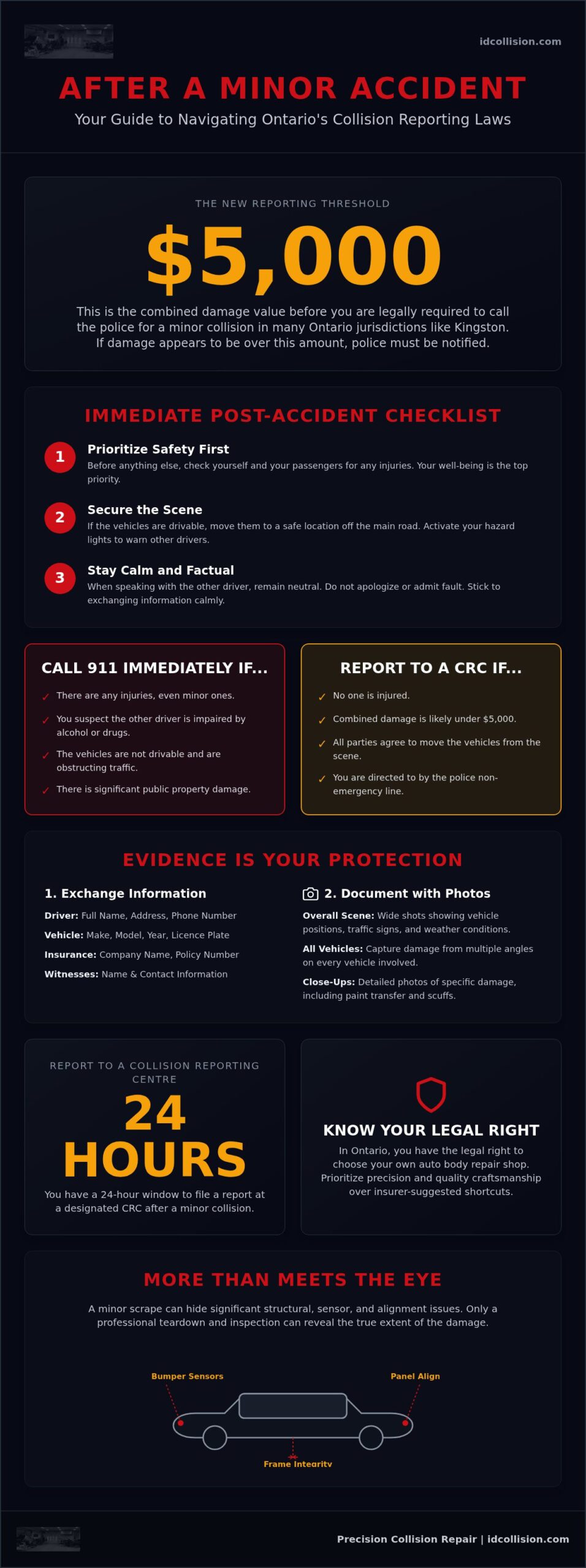
This guide provides a clear checklist to help you navigate the latest 2026 reporting laws and insurance shifts with confidence. Knowing what to do after a minor car accident Ontario drivers often find confusing allows you to handle the situation with authority. We’ll explain the updated $5,000 damage threshold, the 24-hour window for reporting centres, and how to assert your legal right to choose a repairer who values precision. By the end, you’ll have a roadmap for what to do after a minor car accident Ontario to ensure your vehicle is restored to its pre-accident condition without the typical headaches.
Key Takeaways
- Prioritize immediate safety by checking for injuries and moving drivable vehicles to a secure area off the main road.
- Understand the updated 2026 reporting laws, including the $5,000 damage threshold and the 24-hour window for visiting a Collision Reporting Centre.
- Learn exactly what to do after a minor car accident in Ontario to gather the essential evidence needed to protect your insurance benefits.
- Realize your legal right to choose your own repair shop, allowing you to prioritize quality craftsmanship over insurer-suggested shortcuts.
- Recognize the importance of a professional inspection to uncover hidden structural or sensor damage that often lurks behind minor cosmetic scrapes.
Immediate Steps: Safety and Scene Management
The seconds following a traffic collision are often characterized by a sharp rush of adrenaline. It’s easy to feel disoriented. Before you even reach for the door handle, take a moment to check yourself and your passengers for injuries. Understanding what to do after a minor car accident Ontario laws mandate begins with confirming that everyone is physically stable before exiting the vehicle. Your physical well-being is the only thing that cannot be replaced, so don’t rush the initial assessment.
If everyone is unharmed and the cars are still drivable, move them off the main road to the shoulder immediately. Leaving a vehicle in the centre of a busy Kingston street creates a significant hazard for other motorists. Moving your car to a secure area is a critical part of what to do after a minor car accident Ontario to prevent further collisions and keep traffic flowing. Once you’ve reached the shoulder, turn on your hazard lights and use road flares or emergency triangles if you have them. These simple actions signal your presence to others and create a protective barrier around the scene.
Maintaining your composure is perhaps the most difficult task during a fender bender. When you exit the vehicle to speak with the other driver, keep your interactions neutral and focused entirely on the facts. Don’t apologize or admit fault, even if you feel responsible in the moment. Determining liability is a technical process for insurers and investigators. Focusing on the facts is a major component of what to do after a minor car accident Ontario to ensure your insurance claim remains accurate and your legal position is protected.
When to Call 911 vs. Local Police
You must call 911 if there are any injuries, if you suspect the other driver is impaired, or if the vehicles are blocking the road and cannot be moved. For truly minor incidents where everyone is safe and the cars are functional, contact the Kingston Police non-emergency line. They will guide you on whether an officer needs to attend or if you should proceed directly to a reporting centre. Identifying whether your vehicle is safe to drive or requires a tow is the first step in managing the situation with professional precision.
Assessing the Scene for Hazards
Take a quick look around the vehicles for immediate dangers before you begin exchanging information. Check for leaking fuel or coolant, as these fluids can pose a fire risk or create slippery conditions on the pavement. Be alert for downed power lines or unstable debris that may have been dislodged during the impact. Staying focused on safety allows you to manage the situation with precision. This approach ensures that you remain in control of the environment while you wait for assistance or prepare to move your vehicle to a repair facility.
Gathering Essential Evidence and Exchanging Information
Once you’ve secured the scene as discussed in the previous section, you must transition into the documentation phase. This is a critical element of what to do after a minor car accident Ontario drivers need to master to protect their future interests. Approach the other party calmly to begin the exchange of information. You’ll need to collect their full name, home address, and a reliable phone number. Don’t rely on your memory during this high-stress moment. Use your phone to record the exact year, make, model, and licence plate number of every vehicle involved in the collision. Accuracy at this stage prevents confusion or disputes when you eventually file your report.
Insurance details are the next priority. Ask to see the other driver’s insurance pink slip and record the company name, policy number, and the name of the broker. The Financial Services Regulatory Authority of Ontario provides a clear framework for what to do after an accident, stressing that accurate data is your best defence against claim denials. If there are bystanders who saw the event, take a moment to gather their contact information. Independent witness accounts provide an unbiased perspective that can be vital if the other driver’s story changes later. This is another key part of what to do after a minor car accident Ontario regulations support to ensure a transparent claims process.
The Power of Photo Documentation
Digital evidence acts as a principled advocate for your side of the story. Start by taking wide-angle shots of the entire scene to capture the context, including street signs, traffic signals, and weather conditions. These photos help investigators understand the environment at the time of the impact. Next, move in for close-up shots of the damage on all vehicles involved. High-resolution photos of paint transfers and scuffs help our technicians assess the force of the collision. Photographing the other driver’s insurance slip and licence is a crucial step for what to do after a minor car accident Ontario experts recommend to ensure every digit is recorded perfectly for your files.
Recording the Finer Details
Environmental factors often explain why a collision occurred. Note the exact time and the nearest Kingston intersection or landmark. Describe the road conditions clearly: was the pavement wet from a recent rain, or were there icy patches near the curb? Draft a quick sketch showing the positions of the vehicles before and after the impact. These finer details often fade from memory within hours, but having them written down ensures your narrative remains consistent during the restoration process. Once you’ve secured this evidence, you’re in a much stronger position to request a free estimate and begin the journey of restoring your vehicle’s integrity.
Ontario Reporting Laws: Collision Reporting Centres (CRC)
Once you’ve safely gathered evidence at the scene, your next responsibility involves legal compliance. Understanding what to do after a minor car accident in Ontario means knowing when the law requires a formal report. While many drivers grew up with the $2,000 damage rule, the province updated these regulations in 2025. You’re now legally required to report a collision to a Collision Reporting Centre if the combined damage to all vehicles and property appears to exceed $5,000. This increase reflects the rising costs of modern vehicle sensors and specialized materials, which can turn a small scrape into a costly repair very quickly.
Even if the damage looks minor, reporting the incident protects you from potential future liability. If you don’t report an accident that later turns out to be expensive, you could face fines or issues with your insurance coverage. You generally have 24 hours to visit a centre if the police didn’t attend the scene. While the requirements are provincial, municipal services like the Toronto Police Service Collision Reporting Centre provide a helpful blueprint for how these facilities operate across Ontario. Reporting ensures there’s an official, third-party record of the event, which keeps the process transparent for everyone involved.
Where to Report in Kingston
For those in our local community, the Kingston Collision Reporting Centre is located at 701 Division Street, right within the Kingston Police Headquarters. It’s a professional environment designed to help you through the paperwork without the stress of a roadside interrogation. Before you head over, verify their current operating hours as they can vary. You must bring the vehicle involved in the accident along with your driver’s licence, vehicle ownership, and valid insurance documents. Having these items ready allows the staff to process your file with the precision and speed you need to move forward.
What Happens During the Report?
When you arrive, a staff member will conduct a thorough inspection of your vehicle’s exterior. They’ll document the impact points and apply a “damage cleared” sticker to your car. This sticker is vital; it signals to repair shops and authorities that the accident has been properly reported. You’ll also complete a simplified accident report that enters the provincial police database. Insurance companies almost always require this report number before they’ll move forward with your claim. Completing this step correctly is the best way to advocate for yourself and ensure your vehicle restoration stays on the right track.
Navigating Insurance and Your Right to Choose a Repair Shop
Contacting your insurance provider is a critical component of what to do after a minor car accident Ontario residents often find confusing. Even if the damage seems negligible, failing to report the incident can jeopardize your future coverage. Insurance policies often have strict notification timelines, usually within seven days. It’s also important to realize that as of July 1, 2026, many statutory accident benefits are no longer automatically included in Ontario auto insurance policies. This shift makes it even more vital to understand your specific policy coverage before you commit to a repair path. Be transparent with your provider, but remember that reporting the accident is not the same as letting them dictate the entire restoration process.
Understanding what to do after a minor car accident Ontario involves knowing your rights as a policyholder. Ontario law is clear about your consumer rights: you have the absolute legal right to decide where your vehicle is repaired. While insurance companies often suggest “preferred” or “network” shops, these are suggestions, not mandates. Insurers often favour these shops due to pre-negotiated rates, which can sometimes prioritize cost-savings over the meticulous attention your car deserves. Independent shops focus on the long-term health of your vehicle and its resale value. We ensure that every body panel replacement or bumper repair meets rigid safety standards rather than just meeting a budget.
Why Your Choice Matters
Choosing an independent expert ensures that your vehicle’s integrity remains the top priority. We don’t take shortcuts to satisfy an insurer’s bottom line. Our technicians are trained to handle the complexities of modern imports and domestic vehicles, providing a factory-level fit and finish that maintains your car’s longevity. For a deeper look at your entitlements, read our guide on Choosing Your Own Body Shop in Ontario: Know Your Rights. This knowledge prevents you from being pressured into a repair that doesn’t meet your standards. The final choice is always yours.
Dealing with Insurance Adjusters
When you speak with an adjuster, be honest and stick to the facts you recorded at the scene. It’s helpful to request a detailed breakdown of their estimate so you can see exactly what parts and labour they are proposing. Remember that a principled body shop acts as your advocate during this technical phase. We can review the insurer’s estimate with you to ensure no hidden structural issues or sensor calibrations are being overlooked. If you’re ready to start the restoration, you can request a free estimate with us to get an expert second opinion on the damage.
Professional Restoration: Moving Forward with ID Collision
Once you’ve managed the scene and contacted your insurer, the focus shifts to the physical restoration of your vehicle. It’s a common mistake to assume a small scuff is merely cosmetic. Modern vehicles are complex machines. A minor bumper tap can easily knock a blind-spot sensor out of alignment or hide a hairline crack in the structural reinforcement behind the plastic cover. Understanding what to do after a minor car accident in Ontario means looking beyond the surface. We provide a thorough inspection to ensure your vehicle is safe, not just visually restored. Our team acts as a protective expert, identifying these hidden issues before they become safety hazards or costly future repairs.
Our facility offers a comprehensive range of services tailored to every type of collision damage. From Paintless Dent Repair (PDR) for those small dings to full body panel replacement after a harder hit, we handle every task with precision. One of our hallmarks is specialized paint matching for both imports and domestic vehicles. We use advanced technology to ensure the new finish blends perfectly with your original factory paint. This creates a seamless look that restores your car to its true pre-accident condition. To back up our craftsmanship, we offer a lifetime warranty on all workmanship for as long as you own the vehicle. It’s our way of proving that we value integrity and longevity as much as you do.
Our Commitment to Kingston Drivers
We take immense pride in being a local fixture. Serving Kingston, Gananoque, Napanee, and Belleville, we treat every customer with neighbourly care and respect. We understand that insurance paperwork is a significant source of anxiety. That’s why we work directly with your insurance company to streamline the process and reduce your stress. We act as your principled advocate, making sure the claim covers exactly what’s needed for a proper, high-quality repair. It all starts with a free estimate, giving you a clear and honest look at the scope of the work required without any initial commitment.
Restoring Safety and Aesthetics
Aesthetics are important, but safety is the foundation of every repair we perform. Our specialized bumper repair and automotive refinishing processes are designed to maintain your vehicle’s long-term value and structural integrity. For those who want to understand the technical side of how we handle these specific components, we recommend reading The Ultimate Guide to Professional Bumper Repair in Kingston, ON. Knowing what to do after a minor car accident in Ontario includes choosing a shop that doesn’t take shortcuts. Once the structural and cosmetic work is complete, we provide a final detailing. Your car won’t just be fixed; it’ll return to you in pristine condition, helping you move forward with total confidence.
Restoring Your Confidence and Your Vehicle
Knowing what to do after a minor car accident in Ontario transforms a chaotic afternoon into a manageable process of restoration. By prioritizing immediate safety and following the latest provincial reporting thresholds, you’ve already navigated the most difficult hurdles. It’s essential to remember that you hold the legal authority to choose your repair shop. You don’t have to settle for insurer-suggested shortcuts when you can demand the precision and neighbourly care your vehicle deserves.
Our team has served the Kingston community for years, offering expert paint matching for all makes and models alongside a lifetime warranty on all workmanship. We act as your principled advocate, ensuring that every hidden sensor issue or structural dent is addressed with total integrity. If you’re ready to put this incident behind you, Get a Free Collision Repair Estimate in Kingston today. You aren’t just getting a repair; you’re gaining a partner dedicated to your safety. We’re here to help you move forward with total peace of mind.
Frequently Asked Questions
Do I have to report a minor car accident in Ontario if there is no damage?
No, you aren’t legally required to report a collision to a centre if there’s no damage and no injuries. However, you must still exchange information with the other driver involved. It’s often smart to take photos of the vehicles at the scene to prove that no damage occurred. This prevents the other party from making a false claim later on about the condition of their vehicle.
How long do I have to report a car accident to my insurance in Ontario?
You should notify your insurance company as soon as possible, but you generally have seven days to report the accident if you intend to apply for benefits. Failing to meet this timeframe can lead to complications with your claim or even a denial of coverage. Prompt notification allows the insurer to document the facts while they’re fresh, ensuring you receive the support you’re entitled to.
Can my insurance company tell me which body shop to use in Ontario?
No, your insurance company cannot legally dictate which repair facility you use. Under Ontario law, you have the absolute right to choose your own body shop. While insurers might suggest preferred locations to manage their internal costs, you can select an independent expert like ID Collision. This ensures your vehicle is restored with the high standard of craftsmanship and integrity that you expect.
What happens if I don’t report an accident over $2,000?
While many drivers remember the old $2,000 rule, the reporting threshold in Ontario increased to $5,000 of combined damage in 2025. If you fail to report an accident that exceeds this legal limit, you could face provincial fines or a licence suspension. Your insurer might also deny your claim if they find you didn’t follow proper reporting laws, leaving you to pay for all repairs yourself.
Will my insurance rates go up after a minor fender bender?
Your insurance rates might go up, but it depends on your specific policy and who is at fault. Many Ontario drivers have accident forgiveness coverage, which protects your premiums after your first minor at-fault collision. If you don’t have this protection and are found responsible for the accident, your rates could increase. It’s always best to review your policy details with your broker to understand your coverage.
What is the Kingston Collision Reporting Centre’s address and phone number?
The Kingston Collision Reporting Centre is located at 701 Division Street, inside the Kingston Police Headquarters. You can reach them at 613-549-4660. Ensure you bring your driver’s licence, vehicle ownership, and insurance card with you. You generally have 24 hours to report the incident if the police didn’t attend the scene. Checking their current hours before heading over is always a good idea.
Can I get a free estimate for minor dent repair in Kingston?
Yes, we provide free estimates for all services, including minor dent repair and automotive painting. Getting a professional assessment is a key part of knowing what to do after a minor car accident in Ontario. It helps you understand the true cost of the restoration before you decide to file a claim. Our team identifies hidden issues that a simple visual check might miss, protecting your car’s long-term value.
Is a lifetime warranty standard for auto body repair in Ontario?
A lifetime warranty isn’t a legal requirement for all shops, but it’s a vital sign of a principled repairer. At ID Collision, we offer a lifetime warranty on all workmanship for as long as you own the car. This guarantee reflects our commitment to precision and longevity. Choosing a shop that stands behind its work ensures your vehicle is restored to its pre-accident condition without any shortcuts.