
Imagine walking back to your car after a quick stop in downtown Kingston only to find a sharp, deep dent staring back at you. Your mind immediately jumps to the potential for high repair costs and the nightmare of mismatched paint colours that often come with traditional body shop work. You want the quickest, most invisible fix possible, but you are likely wondering: when is PDR not an option for your vehicle? It’s a stressful situation, especially when you’re worried about protecting your car’s resale value and its original factory finish.
We understand that you want to maintain your vehicle’s integrity without breaking the bank or dealing with complex, cold repair processes. This guide will help you learn exactly where the physical limits of paintless dent repair lie and when traditional collision repair is the only safe way to restore your car to its pre-accident condition. We will explore the critical factors of paint elasticity, metal depth, and structural safety that determine the most reliable path forward for your vehicle’s restoration.
Key Takeaways
- Identify why broken paint or cracked clear coats immediately signal that PDR will likely cause more harm than good to your vehicle’s exterior.
- Discover why the specific location of a dent, particularly near roof rails or structural pillars, determines when is PDR not an option due to metal thickness.
- Understand how modern safety technology and ADAS sensors influence whether a panel can be massaged back to shape or requires a more traditional teardown.
- Learn to recognize “metal stretch,” a condition where the impact has physically elongated the fibres beyond the point of simple PDR restoration.
- Gain confidence in choosing between a specialized PDR finish and traditional collision repair to protect your car’s long-term resale value in the Kingston market.
Understanding the Power and Limits of Paintless Dent Repair
Paintless dent repair is a specialized craft that feels almost like magic when performed correctly. It involves using custom-designed tools to gently massage the metal from the backside, slowly returning it to its original factory shape. The beauty of Paintless Dent Repair (PDR) lies in what it leaves behind: your vehicle’s original finish. By avoiding sanding, body fillers, and repainting, we preserve the “E-coat.” This is the factory-applied layer responsible for maximum corrosion resistance, which is especially vital in Kingston. Given our local climate and the heavy use of road salt, keeping that factory seal intact is your best defence against premature rust.
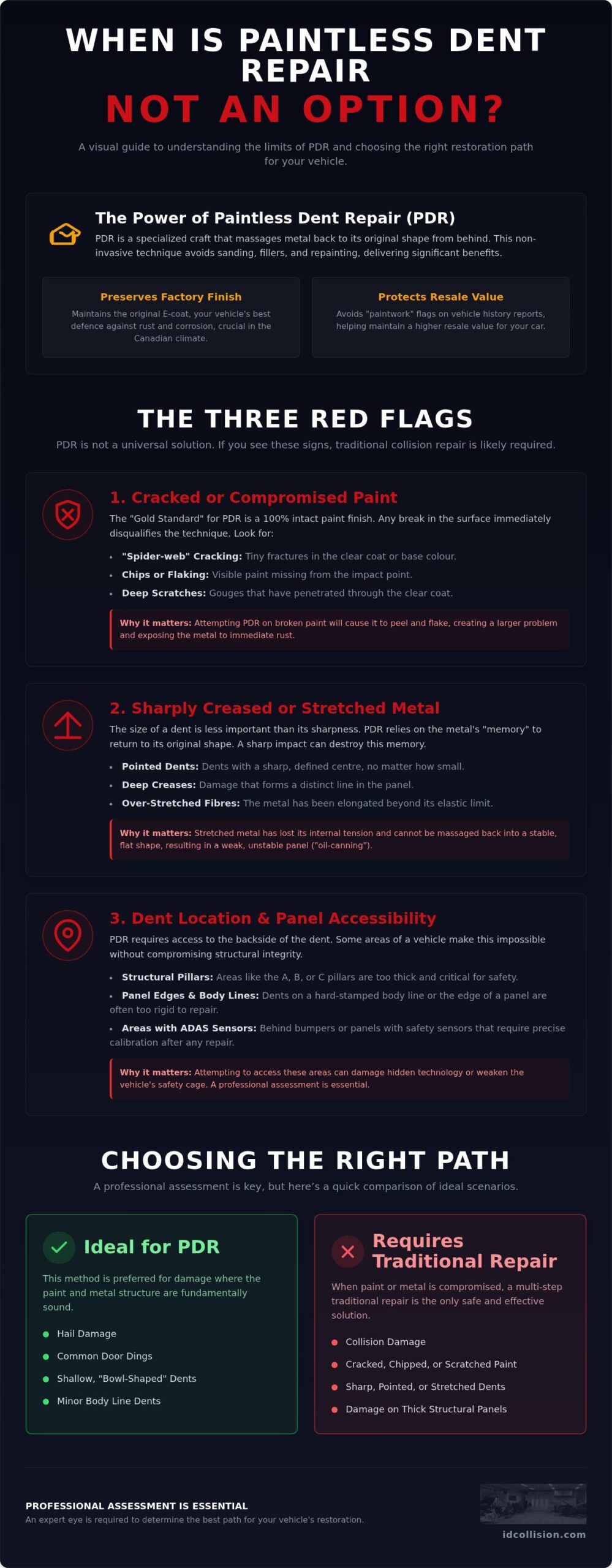
While this method is the preferred choice for hail damage and common door dings, it isn’t a universal fix. There is a clear “Gold Standard” for this technique: the paint finish must be 100% intact. If you see cracks, chips, or flaking within the damaged area, that is usually when is PDR not an option for your car. Without a solid, flexible paint surface, the mechanical pressure of the repair process will only cause the existing damage to spread or peel.
The Science of Metal Memory
Most modern vehicles are built with high-strength steel or lightweight aluminium. Both materials possess a “memory” of their original factory mold. Our technicians use specialized, high-intensity LED lighting to read the “orange peel,” which is the natural texture of your paint finish. By observing how the light bends and reflects off the dent, we can identify exactly where the metal is high or low. During the process, we often use controlled heat to increase the elasticity of the paint. This is a critical step in our Kingston shop; it ensures the clear coat remains pliable and doesn’t fracture as we manipulate the metal beneath it.
Why PDR is Better for Your Resale Value
Choosing paintless dent repair Kingston drivers rely on helps keep your vehicle’s history report clean. Traditional repairs often require painting multiple panels to ensure a perfect colour match. This can lead to “paintwork” flags on history reports, which may lower your resale value. Since PDR is non-invasive, it maintains the car’s original parts and factory finish. It is also a more cost-efficient path because it eliminates the need for expensive paint materials and lengthy booth drying times. However, if the impact was severe enough to stretch the metal fibres, you must recognize when is PDR not an option. In those cases, traditional restoration is the only way to ensure the panel is structurally sound and aesthetically perfect.
The Three Red Flags: When Paint and Metal Integrity Prevent PDR
While PDR is an incredible tool for modern vehicle restoration, it has strict physical boundaries. Identifying when is PDR not an option early in the process saves you from the frustration of a repair that simply cannot hold. The technique relies entirely on the paint’s ability to flex and the metal’s capacity to return to its original state. When either of these properties is compromised by the force of an impact, traditional collision repair becomes the only safe and effective path forward.
Identifying Cracked or Compromised Paint
Before we even pick up a tool, we examine the impact site for “spider-web” cracking. These tiny, radial fractures in the clear coat or base coat indicate that the paint’s structural integrity is gone. In our Eastern Ontario climate, even a microscopic crack is a gateway for road salt and moisture to reach the underlying steel. Attempting to massage the metal in these cases will only cause the paint to flake away further, leading to immediate rust issues. Furthermore, if a panel has been repainted in the past, it may be prone to “delamination.” This is where the secondary paint layers peel away from the metal during the repair process because they lack the bond strength of a factory-applied finish.
The ‘Pointed’ Dent Problem
It is a common misconception that larger dents are harder to fix. In reality, a large, shallow “bowl” dent is often a perfect candidate for PDR, while a tiny, sharp “crease” may be impossible to resolve. When an impact is sharp enough to create a point, the metal fibres at the very centre have physically elongated. Once this metal is over-stretched, it loses the internal tension required to “remember” its original shape. Oil-canning is the term used to describe the unstable “popping” movement that occurs when over-stretched metal can no longer maintain its structural tension.
Beyond the metal itself, we must also consider previous bodywork and location. If a panel was previously repaired using body fillers like “Bondo,” PDR is not an option because the filler is rigid and will crack under the pressure of our tools. Similarly, dents located on the very edge of a door or sitting directly over a double-walled support brace often provide no access for the specialized rods used in the process. If you are unsure about the depth or location of your damage, you can always request a professional estimate to determine if your vehicle qualifies for a non-invasive restoration.
Beyond the Surface: Why Modern Vehicle Tech and Location Matter
Modern vehicle engineering has evolved rapidly, moving far beyond simple sheets of stamped steel. Today, your car is a sophisticated assembly of high-strength alloys and integrated electronics. While a panel might look like a prime candidate for a quick fix, the internal architecture of the vehicle often dictates a different path. Understanding when is PDR not an option requires looking past the surface damage and considering the complex systems hidden beneath the skin. Safety and structural integrity must always take priority over a purely cosmetic approach.
Sensors, Cameras, and Recalibration
Advanced Driver-Assistance Systems (ADAS) have changed the rules for collision specialists. If a dent is located near sensors for blind-spot monitoring, park assist, or autonomous braking, a simple massage of the metal is rarely enough. Even a slight shift in the panel’s geometry can misalign a sensor by a fraction of a degree, potentially causing a safety system to fail when you need it most. Following strict OEM (Original Equipment Manufacturer) repair procedures is non-negotiable in these instances. For example, a small ding in a plastic bumper cover often necessitates a full teardown and electronic recalibration. If your vehicle has sustained this type of impact, our team’s approach to Bumper repair Kingston ON ensures all safety tech is verified and functional before you get back on the road.
Hard-to-Reach Areas and Double-Walled Panels
The core requirement for traditional PDR is access. Technicians typically need to reach the backside of the damaged metal with specialized rods to apply precise pressure. However, many areas of a modern vehicle are double-walled or reinforced with non-removable interior braces for crash protection. Roof rails and A-pillars are prime examples; the metal in these “safety cages” is often too thick or layered for PDR tools to manipulate effectively. While “glue pulling” is a modern alternative that works from the outside of the panel, it has its own set of physical limits. If the dent is located directly over a structural weld or a rigid internal support, the metal simply won’t have the room to move back into place. In these scenarios, when is PDR not an option becomes a matter of physical access and metallurgy.
Material composition also plays a significant role in repair feasibility. High-strength steels used in modern pillars are designed to be incredibly rigid, making them resistant to the gentle pressure used in PDR. Similarly, if your vehicle features carbon fibre panels, PDR is completely off the table. Carbon fibre does not have “metal memory,” it doesn’t bend; it either holds its shape or it shatters. When dealing with these advanced materials, traditional replacement or specialized composite repair is the only way to ensure the vehicle remains as safe as the day it left the factory.
PDR vs. Traditional Collision Repair: Choosing the Right Path
Deciding between paintless dent repair and traditional bodywork is a matter of balancing speed against the long-term health of your vehicle. While PDR is often celebrated for its efficiency, pushing its limits can lead to disappointing results. Attempting a “cheap” PDR fix on a dent that is too deep or sharp often results in a wavy finish or paint that eventually chips and fails. This is exactly when is PDR not an option for an owner who values the longevity of their car. If the repair cannot be completed to a factory standard using only massage techniques, we must pivot to traditional restoration to ensure the panel remains protected.
Traditional collision repair is a methodical, multi-stage process. Our technicians pull the metal back to its original alignment, use high-quality fillers to smooth the surface, and sand it to a factory-perfect contour. In some cases, we utilize a “hybrid” approach. This involves using PDR techniques to minimize the amount of filler required while still proceeding with a full paint cycle to address surface imperfections. While PDR can often be completed in a few hours, traditional repairs typically take several days or even weeks. This extra time is necessary to allow for proper curing of primers, base coats, and clear coats in a controlled environment.
The Science of Colour Matching in Kingston
One of the biggest anxieties for car owners is the fear of mismatched paint. In Kingston, our vehicles are subjected to intense seasonal UV exposure that can cause paint to fade at different rates depending on how the car is parked or stored. Professional shops don’t just rely on factory paint codes; they use computerized spectrophotometers to analyze the current state of your vehicle’s finish. This ensures the new paint blends seamlessly with the aged panels. To understand the complexity of this process, you can explore the details of Automotive refinishing Kingston specialists provide to achieve an invisible transition.
When Traditional Repair is the Safer Investment
There are times when traditional repair is not just an alternative, but a necessity for structural integrity. If an impact has weakened a panel’s internal reinforcements, PDR cannot restore that lost strength. Traditional repair allows us to inspect and, if necessary, replace the underlying components. For Kingston families, choosing the more comprehensive repair path provides peace of mind, especially when backed by a lifetime warranty on all workmanship. If the damage is so severe that the metal has lost its “memory” entirely, panel replacement becomes the only way to guarantee the vehicle’s safety in a future collision. If you’re unsure which path your vehicle requires, request a professional estimate to receive a clear, honest assessment of your repair options.
Professional Assessment in Kingston: Why an Expert’s Eye is Essential
Many drivers try to save time by sending smartphone photos to a shop for a quick quote. While technology is helpful, a simple camera lens often hides the subtle “stretch” in the metal or microscopic fractures in the clear coat. To truly determine when is PDR not an option, a technician must use specialized “line boards” or “fog boards.” These tools reflect a consistent, geometric pattern onto the vehicle’s surface. If those lines are broken or distorted in a specific way, it reveals structural stretching that a standard phone camera simply cannot capture. A physical inspection is the only way to see the true state of the metal.
At ID Collision, we operate as a “Protective Expert” for our clients. This means we don’t just look at the dent; we look at the health of the entire vehicle. We check for displaced sensors, compromised internal braces, and the resilience of the surrounding paint. Serving the local community from Gananoque to Napanee, we pride ourselves on providing honest, straight-talk advice. If we explain when is PDR not an option for your specific case, it’s because we are prioritizing your car’s long-term safety and resale value over a quick, temporary fix that might fail later.
The Role of the Insurance Advocate
Dealing with insurance adjusters can be a high-stress experience, especially when you’re worried about repair costs. It is your legal right in Ontario to choose your own repair facility, regardless of any “preferred” lists an insurance company might suggest. We act as your advocate throughout this entire process. Our team works with major insurers to ensure your vehicle receives the correct level of care. If a PDR attempt would compromise the paint’s longevity, we provide the technical documentation needed to justify a full Collision repair Kingston Ontario drivers trust for quality. We ensure the focus remains on the best repair for your car, not just the cheapest one for the insurer.
Get a Free Estimate Today
The best way to move forward with confidence is to visit our Kingston centre for a hands-on inspection. A physical assessment allows our technicians to feel the tension in the metal and check the backside of the panel for access issues. When you come in, please bring your insurance information and any relevant vehicle history. We will provide a transparent breakdown of your options, whether that involves a specialized PDR massage or a traditional refinishing process. Don’t leave your car’s integrity to guesswork or blurry photos. Book your free repair estimate at ID Collision today and let our experts guide you toward a total restoration.
Secure Your Vehicle’s Future with an Expert Assessment
Understanding the physical limits of paintless dent repair helps you make the best decision for your car’s longevity and safety. Whether you are dealing with a simple door ding or a complex impact near sensitive safety sensors, the goal is always a restoration that lasts. Identifying exactly when is PDR not an option ensures you don’t waste time on a fix that won’t hold or, worse, compromises your vehicle’s structural integrity. As a locally owned and operated shop in Kingston, we take pride in acting as your principled advocate. We provide direct insurance claim assistance to make the restoration process as steady and stress-free as possible.
Every repair we perform is backed by a lifetime warranty on all workmanship, giving you total confidence in the quality of our craft. Our team is ready to provide the honest, technical guidance you need to protect your investment. Contact ID Collision in Kingston for a Professional Dent Assessment and let us help you choose the right path forward. You deserve a vehicle that looks perfect and remains as safe as the day it left the factory.
Frequently Asked Questions
Can PDR be done if the paint is scratched?
Paintless dent repair is generally not recommended if the scratch has penetrated the clear coat or base coat. If the paint is physically broken, the mechanical pressure of the PDR process will likely cause the surrounding finish to flake or peel further. While minor surface scuffs can sometimes be polished out after the dent is removed, deep scratches usually require traditional refinishing to prevent rust.
Will a dent come back after Paintless Dent Repair?
No, a dent will not return once it has been professionally repaired. The PDR process works by restoring the metal to its original factory “memory” or mold. Once the tension is released and the metal is massaged back into its proper alignment, it stays there permanently. Unless the vehicle sustains a new impact in the same location, the surface will remain smooth for the life of the car.
How much does PDR cost compared to traditional bodywork in Ontario?
PDR is a significantly more cost-effective solution than traditional collision repair. Because the process eliminates the need for expensive paint materials, primers, and the extensive labour hours required for sanding and drying, the total cost is often a fraction of a traditional bill. It is the most efficient way for Ontario drivers to restore their vehicles without the high overhead of a full paint booth cycle.
Can PDR fix dents on plastic bumpers?
PDR tools and techniques are designed specifically for metal panels like steel and aluminium, so they cannot be used on plastic. Plastic does not have “metal memory” and behaves differently under pressure. If your bumper is dented, it requires specialized bumper repair techniques involving controlled heat or, in cases of structural cracks, a full panel replacement to ensure the safety sensors remain functional.
Does my insurance cover Paintless Dent Repair for hail damage?
Yes, most insurance providers in Ontario cover PDR under the comprehensive portion of your policy. This is the standard method for addressing hail damage because it preserves the factory finish and is preferred by insurers for its efficiency. We provide direct insurance claim assistance to help you navigate the paperwork and ensure the best repair method is approved for your vehicle’s specific needs.
How long does a typical PDR appointment take?
Most PDR repairs are completed in a single day, often taking between one and four hours depending on the size and number of dents. This is much faster than traditional bodywork, which can keep your car in the shop for a week or more. The speed of the process makes it an ideal choice for busy Kingston residents who need their vehicles back on the road quickly.
Can PDR fix a dent on a body line or crease?
Skilled technicians can often restore dents on body lines, but these are much more complex than soft dings. If the impact has caused the metal to stretch beyond its elastic limit or if the crease is too sharp, that is when is PDR not an option for a flawless result. We use specialized lighting to determine if the metal still has the structural tension required to return to its original shape.
Is PDR an option for older vehicles from the 90s or earlier?
PDR can be performed on older vehicles, but the condition of the paint is the deciding factor. Paint on cars from the 90s or earlier is typically more brittle and less flexible than modern automotive finishes. We carefully assess the age and elasticity of the clear coat to ensure it won’t crack during the repair, as preserving the original look of a classic vehicle is our top priority.