
Imagine driving home along Highway 401 during a Lake Ontario snow squall. The visibility is already poor, but as you flip on your high beams, you realize the light isn’t cutting through the dark. It’s just a dull, yellow blur. Many drivers in our community struggle with this exact scenario, watching their once-clear lenses turn cloudy and dangerous over time. If you have noticed this haze, seeking professional headlight restoration Kingston is the most effective way to ensure you aren’t left in the dark during our harsh winters.
You likely feel the frustration of squinting through a hazy lens, worrying if your vehicle will even pass its next Ontario safety inspection. We understand how stressful it is to feel unprotected behind the wheel. In this guide, we’ll explain why plastic lenses oxidize and how professional-grade treatments differ from the temporary fixes found in DIY kits. You’ll learn how to restore the original colour and clarity with a finish that lasts for years. We’ll also cover the specific Ontario regulations you need to know to stay compliant and keep your family safe during nighttime travels.
Key Takeaways
- Understand how Kingston’s high-UV summers and salt-heavy winters accelerate the chemical oxidation of your vehicle’s polycarbonate lenses.
- Discover why severe yellowing can reduce light output by as much as 70 per cent, creating significant safety risks during nighttime driving.
- Compare the longevity gap between consumer kits and professional headlight restoration Kingston to see why professional-grade abrasives provide a more durable finish.
- Learn the multi-stage wet sanding and masking techniques used to systematically remove oxidation without damaging your car’s paint or chrome.
- Identify the specific maintenance steps required to protect your restored clarity from harsh car wash chemicals and environmental road grime.
Why Headlights Turn Yellow: The Kingston Environmental Factor
Most drivers assume that the haze on their lenses is just a layer of stubborn road grime. In reality, it is a complex chemical transformation. Modern vehicles have moved away from the heavy, breakable glass units of the past in favour of polycarbonate plastic. While this material is lighter and more resistant to impacts from flying stones, it is also highly porous. This porosity makes it vulnerable to the elements, especially when you consider the evolution of automotive headlamp technology and the demand for more aerodynamic designs. In our region, your vehicle faces a relentless cycle of UV exposure and chemical attacks that eventually compromise your visibility.
If you frequent Highway 401, your car is essentially subjected to a high-speed sandblasting session every time you drive. Tiny pieces of debris create microscopic pits in the plastic surface. These pits act as anchor points for dirt and salt, accelerating the yellowing process. When the surface is compromised, it no longer allows light to pass through cleanly. Instead, the light hits the oxidation and scatters, which is why your beams feel “dim” even with new bulbs. Professional headlight restoration Kingston is designed to address this deep-seated damage rather than just cleaning the surface.
The Role of UV Radiation in Ontario
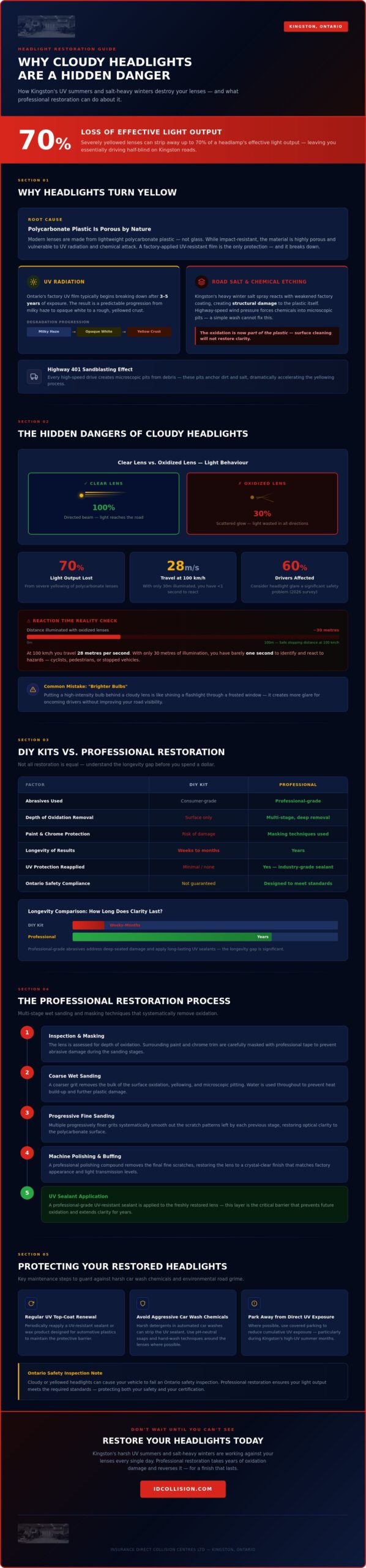
Manufacturers apply a thin, protective UV-resistant film to new polycarbonate lenses at the factory. This coating is the only thing standing between the plastic and the sun’s rays. In Ontario, this film typically begins to break down after three to five years of exposure. You will notice a predictable visual transition as this happens. It starts as a subtle, cloudy “milkiness” before progressing to an opaque white. Eventually, the surface develops a rough, yellowed crust that blocks a significant portion of your light output. Polycarbonate oxidation is the primary cause of lens cloudiness.
Road Salt and Chemical Etching
Kingston’s winter climate adds another layer of difficulty for your vehicle. The heavy salt spray used on our roads doesn’t just sit on the surface; it reacts with the weakened factory coating. This chemical etching creates a dull finish that traditional car soaps cannot penetrate. Because the salt and road chemicals are pressed into the microscopic pits by wind pressure at highway speeds, the damage becomes structural to the lens. A simple wash won’t work because the oxidation is now part of the plastic itself. This is why a methodical, multi-stage restoration is the only way to truly reclaim the clarity you need for safe winter driving.
The Hidden Dangers of Cloudy Headlights
Cloudy headlights do more than just make a vehicle look aged; they actively sabotage your ability to navigate safely at night. When a lens becomes oxidized, the surface is no longer smooth and clear. Instead of focusing a sharp beam of light onto the pavement, the hazy plastic scatters the light in every direction. This creates a “glow” effect rather than a directed beam. Investing in professional headlight restoration Kingston ensures that your light is actually reaching the road where it belongs, rather than being wasted as a dull, useless shimmer. Industry research indicates that severe yellowing can strip away up to 70 per cent of a headlamp’s effective light output, leaving you essentially driving half-blind.
This loss of clarity isn’t just a risk for you. It’s a danger to everyone on the road. On poorly lit Kingston side streets, a 70 per cent reduction in light means you might not see a cyclist or a pedestrian until it’s too late. It also creates a hazardous glare for oncoming traffic. A 2026 survey found that 60 per cent of drivers consider headlight glare a significant safety problem. When your lenses are cloudy, they refract light upward into the eyes of other drivers, increasing the risk of a collision. To ensure your vehicle remains a safe presence on the road, you can explore our specialized restoration services to reclaim your nighttime vision.
Nighttime Visibility and Reaction Times
Speed and light are inextricably linked. At 100km/h, your vehicle travels nearly 28 metres every second. If your oxidized lenses only illuminate 30 metres ahead, you have barely one second to react to an obstacle. This lack of visibility leads to significant driver fatigue as your brain strains to interpret the dim, hazy shapes in the distance. Many drivers try to solve this by installing “brighter bulbs,” but this is a mistake. Putting a high-intensity bulb behind a cloudy lens is like shining a flashlight through a frosted window; it just creates more glare without improving your reach.
Ontario Safety Inspection Requirements
Maintaining clear lenses is also a legal necessity in our province. According to Ontario vehicle safety inspection standards, headlights must not have any cloudiness that reduces light transmission. If a technician determines your lenses are too hazy, your vehicle will fail its safety inspection. This can lead to unexpected repair costs and delays when you’re trying to sell or register a vehicle. Driving with impaired lighting can also result in fines under the Highway Traffic Act. Being proactive with your maintenance is the best way to avoid these legal and financial headaches before they arrive.
DIY Kits vs. Professional Headlight Restoration in Kingston
It is tempting to grab a retail restoration kit while picking up supplies at a local hardware store. These kits promise a quick fix for a fraction of the cost of professional service. However, there is a significant difference between a cosmetic “clean” and a structural restoration. Most consumer-grade kits provide limited sandpaper grits and a basic wipe-on sealant that lacks the chemical bonding necessary for longevity. If you want a result that lasts years rather than weeks, choosing professional headlight restoration Kingston is the more sustainable investment. We often see customers who have tried two or three different kits before realizing that the haze keeps returning, costing them more in the long run.
The primary issue with DIY methods is the “longevity gap.” Consumer kits typically fail within six months because they don’t provide a durable UV-resistant barrier. Without this protection, the freshly sanded polycarbonate is even more vulnerable to the sun than it was before. There is also a physical risk to your vehicle. Many kits include drill-mounted pads that can generate excessive heat. If used incorrectly, these attachments can “burn” or melt the plastic, creating permanent distortions that no amount of sanding can fix. Our process uses controlled, multi-stage abrasives and professional-grade cooling techniques to ensure the lens remains perfectly smooth and structurally sound.
The Problem with “Quick Fixes”
The internet is full of “hacks” like using toothpaste or bug spray to clear cloudy lenses. We strongly advise against these. Toothpaste is a mild abrasive that might provide a few days of clarity, but it offers zero protection. Bug spray is even more dangerous. The DEET in bug spray actually melts the top layer of plastic to create a temporary shine, which permanently ruins the lens’s integrity. Chemical-only kits are similarly flawed; they strip away the remaining factory protection without properly leveling the surface, leaving the plastic porous and prone to rapid yellowing.
The Professional Advantage
At Insurance Direct Collision Centres LTD, we treat your lighting as a critical safety component. Our technicians use specialized tools and industrial-grade sealants that are not available in retail stores. These sealants create a hard, crystal-clear shell that blocks UV rays and resists chemical etching from road salt. This precision-focused approach ensures that the finish remains clear through several Ontario winters. This level of care is a natural extension of our other auto body restoration services, where we prioritize the longevity and safety of every vehicle that enters our shop. We don’t just want your car to look better today; we want it to remain safe for years to come.
How We Restore Clarity: Our Step-by-Step Process
Professional headlight restoration Kingston is a meticulous industrial process designed to strip away damage without compromising the lens’s structural integrity. Before we touch the plastic, we begin with rigorous preparation. We mask off all surrounding body panels, chrome trim, and rubber seals with high-quality automotive tape. This protective barrier ensures that our abrasives never come into contact with your vehicle’s paint or delicate finishes. At Insurance Direct Collision Centres LTD, we take this step seriously because precision is the foundation of a lasting repair.
Once the vehicle is protected, the restoration follows a logical progression:
- Multi-stage wet sanding to remove the yellowed, oxidized crust.
- Surface refinement to eliminate microscopic sanding marks.
- High-speed polishing to achieve total optical transparency.
- Chemical decontamination to prepare the plastic for the final sealant.
Precision Sanding and Surface Levelling
We use a sequence of specific grit levels, typically starting around 800 and finishing at 3000. This gradual progression is essential for creating a smooth, level base. Our technicians are trained to identify exactly when the oxidation layer is gone by observing the colour and consistency of the sanding residue. During the initial stages, the water runoff typically looks milky or yellow; we only move to the next stage once the runoff is completely clear. As we move to the ultra-fine grits, we manage heat buildup carefully. If the plastic gets too hot during this phase, it can warp or smear, which permanently ruins the clarity. This methodical approach levels the surface perfectly, ensuring the plastic is ready to bond with the protective coating.
The Critical UV Coating Phase
The most important step is applying the high-solids UV-curing clear coat. While many retail kits use a thin liquid that evaporates quickly, we use a professional spray-on coating. This industrial sealant forms a permanent chemical bond with the polycarbonate. It acts as a sacrificial layer, absorbing the radiation that would otherwise cause the plastic to yellow again. The final coating must be cured properly to realize a factory-like finish that resists the harsh summer sun. Without this industrial-strength barrier, even the most thorough sanding job will fail within a few months. To get your vehicle back to factory standards and ensure long-term visibility, you can book your restoration appointment today.
Protecting Your Restored Headlights and Next Steps
Once your vehicle leaves our shop with crystal-clear lenses, the focus shifts to preservation. You have invested in professional headlight restoration Kingston, and a few simple habits will ensure that clarity remains for years. The most common threat to a fresh UV coating is the use of high-pH car wash soaps found in some automated facilities. These harsh chemicals are designed to strip road film, but they can also prematurely degrade the protective sealant. We recommend hand-washing your vehicle whenever possible using pH-balanced automotive shampoos. This small change in your routine protects the integrity of the finish and prevents the return of the yellow haze.
The impact of clear lighting on your vehicle’s overall appearance cannot be overstated. Even a perfectly polished car looks aged if the lenses are cloudy. Restoration is often the final piece of a complete exterior refresh. If you want to elevate your car’s look even further, you might also consider alloy wheel repair Kingston to address curb rash and oxidation on your rims. Combining these services restores the factory-fresh look that increases your vehicle’s resale value and pride of ownership. It acts as a shield for your investment.
Long-term Maintenance Tips
Applying a high-quality automotive wax or a dedicated ceramic sealant every few months is a smart move. This adds an extra layer of protection against the sun and industrial fallout. During Kingston winters, keep your lenses clear of salt buildup. Use a soft microfibre cloth and plenty of water to rinse away brine. Never use a dry brush or ice scraper on the plastic lenses. This will create deep scratches that compromise the seal and allow moisture to penetrate the polycarbonate surface. If you notice your vehicle pulling to one side after a harsh winter, it is also worth scheduling a precision wheel alignment Kingston to ensure your suspension geometry hasn’t been knocked out of spec by potholes or road damage.
When Restoration is Not Enough
Sometimes, restoration is no longer an option. If your headlights have “crazing,” which looks like tiny internal cracks within the plastic, the damage is likely too deep to sand away. Similarly, if you notice standing water or heavy condensation inside the housing, the factory seal has failed. In these cases, replacement is the only way to ensure safety. Our team provides honest, professional assessments to ensure you don’t spend money on a restoration if the unit’s structural integrity is gone. We want you to have the most effective lighting possible for the road ahead.
Book Your Assessment at Insurance Direct Collision Centres LTD
We take pride in serving our neighbours and ensuring every car on our local roads is safe for nighttime driving. At Insurance Direct Collision Centres LTD, we stand behind our work with a lifetime warranty on our craftsmanship. This commitment to quality means you can drive with confidence knowing your restoration was done correctly the first time. We focus on doing things right so you don’t have to worry about your visibility failing when you need it most. Contact Insurance Direct Collision Centres LTD today for a free estimate on your headlight restoration.
Reclaim Your Nighttime Clarity
Clear visibility is the foundation of every safe journey, especially when navigating the unpredictable weather of Eastern Ontario. We have explored how professional techniques overcome the limitations of DIY kits by using industrial-grade UV sealants that withstand our salt-heavy winters. By addressing oxidation now, you aren’t just improving your vehicle’s appearance; you are ensuring that your headlamps provide the maximum light output required to keep your family safe on the road. Straining to see through a yellowed haze shouldn’t be part of your daily commute.
As a locally owned and operated business in Kingston, we take pride in being your principled advocate for vehicle safety. Our expert colour matching and refinishing specialists apply the same precision to your lenses as they do to complex collision repairs. This level of technical excellence is shared by leaders in other specialized fields; for instance, those interested in architectural water features can explore AFB Group’s rates for turnkey engineering, manufacturing, and installation of fountain projects. We stand behind every service with a lifetime warranty on workmanship, giving you the peace of mind that your results will last. Trusting a professional for your headlight restoration Kingston ensures you can drive with confidence throughout every season.
Restore your nighttime safety—book your headlight restoration in Kingston today!
We look forward to helping you see the road ahead more clearly and keeping our community safe one vehicle at a time.
Frequently Asked Questions
How long does professional headlight restoration take to complete?
Professional headlight restoration Kingston typically takes between one and two hours to complete. This timeframe allows our technicians to move through the multi-stage sanding, polishing, and sealing process with the precision your vehicle deserves. While we work efficiently, we never rush the curing phase for the protective UV coating. You can drop your car off and have it back the same morning, ensuring you are ready for safe nighttime driving without a long delay.
Will the yellowing come back after the restoration is finished?
The yellowing will not return for several years when a professional-grade UV-resistant clear coat is applied. Unlike consumer kits that offer temporary fixes, our industrial sealants form a permanent bond with the polycarbonate. This barrier blocks the oxygen and UV rays that cause oxidation. If you follow basic maintenance, such as regular washing and occasional waxing, your lenses will maintain their factory-like clarity through many Ontario winters.
Is it cheaper to restore my headlights or replace the entire assembly?
Restoration is almost always the more cost-effective choice compared to purchasing a new assembly. Replacement units for modern vehicles, especially those with integrated LED or adaptive technology, can cost hundreds or even thousands of dollars per side. Restoration provides a similar safety outcome for a fraction of that investment. It is a principled way to maintain your vehicle’s value without the unnecessary expense and environmental waste of discarding a functional housing.
Can you restore headlights that have moisture trapped inside them?
We cannot restore headlights that have moisture trapped inside the housing. Internal condensation indicates that the factory seal between the lens and the body has failed or the housing is cracked. Restoration is a surface-level process designed to remove exterior oxidation and pitting. If your lights are foggy on the inside, we will provide an honest assessment and likely recommend a full replacement to ensure your electrical components remain protected from water damage.
Does headlight restoration improve the resale value of my car?
Improving your headlight clarity definitely increases the resale value of your vehicle. Potential buyers often view cloudy lenses as a sign of neglect, which might make them question the car’s overall mechanical health. Crystal-clear headlights create a strong first impression and prove that you prioritize safety. It also ensures the vehicle passes the Ontario safety inspection, making the sale process much smoother for both you and the buyer.
What is the difference between a lens polish and a full restoration?
A lens polish is a temporary cosmetic touch-up, while a full restoration is a structural repair. Polishing simply buffs the surface to a shine without removing the deep-seated oxidation or applying a permanent UV barrier. A full headlight restoration Kingston involves removing the damaged plastic layer through systematic sanding and then sealing it with an industrial coating. This process addresses the root cause of the cloudiness rather than just hiding it for a few weeks.
Can I drive my car immediately after the restoration is done?
You can drive your vehicle immediately after the service is finished. We use advanced UV-curing technology that hardens the protective sealant in minutes, so there is no risk of the finish smearing on your way home. However, we recommend waiting at least 48 hours before visiting an automated car wash. This allows the chemical bond to reach its maximum strength against the high-pressure jets and harsh soaps used in those facilities.
Is headlight restoration covered by my insurance company after an accident?
Insurance companies typically cover headlight restoration or replacement if the damage was caused by a covered collision. If your lenses were cracked or scuffed during an accident, the repair is usually included in your claim. However, standard insurance policies don’t cover restoration for gradual yellowing or UV oxidation caused by age and environmental exposure. We can help you navigate the paperwork if the restoration is part of a larger collision repair.